
Views: 0 Author: Site Editor Publish Time: 2026-09-21 Origin: Site


Traditional sanitary ware manufacturing relies heavily on sheer physical stamina. For decades, factory floors depended on human operators to cast, move, and finish heavy clay products. Today, this reliance on manual labor is a critical bottleneck. It introduces massive operational costs, frequent worker injuries, and inevitable human error into the production cycle.
Forward-thinking plant managers are modernizing their facilities to navigate these escalating hurdles. Transitioning from manual labor to mechanized production is no longer a luxury for industry giants. It is a fundamental necessity for scaling operations and surviving in a tight global market. Integrating advanced equipment drastically reduces manual workloads while simultaneously boosting overall yield and product consistency.
Labor Reduction: Modern equipment automates physically exhausting tasks like slip casting, demolding, and material handling to eliminate manual exertion.
Glazing Precision: Intelligent systems remove the inconsistencies and health hazards of manual spraying to guarantee a flawless finish.
Cost Efficiency: Automation delivers an aggressive Return on Investment by lowering labor costs, minimizing material waste, and slashing post-firing defect rates.
Worker Safety: Shifting hazardous tasks to machines protects operators from toxic fumes, silica dust, and chronic back injuries.
The sanitary ware sector is undergoing a massive transformation driven by external market pressures. Rising energy costs and stringent environmental regulations force factories to rethink their entire operational footprint. Relying on outdated manual processes wastes raw materials and consumes excess firing energy due to high rework rates.
Furthermore, the global supply chain demands faster turnaround times and zero-defect quality. Industry leaders are adopting data-driven manufacturing. They utilize sensor-rich machinery to monitor ambient humidity, slip viscosity, and spray pressure in real time. This shift from intuitive craftsmanship to empirical science allows modern plants to maintain peak output while strictly controlling their carbon footprint and resource consumption.
Traditional craftsmanship holds intrinsic value, but operating a high-volume factory solely with human hands introduces severe vulnerabilities. Plant managers must objectively evaluate the hidden financial drains that erode profit margins daily.
Slip casting and demolding break down the human body. Operators lift, rotate, and transport water-logged plaster molds countless times per shift. A standard unfired ceramic toilet easily weighs over 25 kilograms. Continuous manual handling of these awkward shapes inevitably leads to musculoskeletal injuries, chronic fatigue, and physical exhaustion.
Human fatigue directly correlates with erratic product quality. As a shift progresses, an operator's precision naturally deteriorates. This fatigue manifests as uneven glaze application, missed spots in intricate internal trapways, or handling marks pressed into soft clay. Specifically, these micro-errors often go unnoticed until the product exits the tunnel kiln. The result is structural defects, micro-cracks, and a devastatingly low First-Pass Yield.
Global manufacturing faces a severe labor shortage. Young workers reject the dusty, sweltering conditions of traditional ceramic plants. Consequently, hourly wages and turnover rates skyrocket. Coupled with rising workplace injury compensation and health insurance premiums, the financial weight of manual processing is entirely unsustainable.
Industry leaders are aggressively turning to technology to combat labor scarcity. The transition from isolated manual workstations to interconnected production lines represents a paradigm shift in factory design.
Manual labor guarantees unpredictable output. Integrating automated systems shifts the facility to a highly predictable manufacturing science. Programmable logic controllers govern critical machine parameters like hydraulic casting pressure, ambient drying temperature, and atomized glaze thickness. This strict algorithmic control guarantees the thousandth washbasin produced is structurally identical to the first.
Modern equipment never operates in isolation. Automated cells communicate seamlessly to establish a continuous production flow. For instance, humidity sensors in drying chambers automatically signal material handling systems. The systems transport specific batches to the finishing area exactly when they reach optimal moisture levels. This eliminates manual tracking and costly idle time.
Executing a facility upgrade does not require an overnight overhaul. Plant managers achieve the most immediate results by targeting specific labor-intensive bottlenecks.
Traditional casting relies on porous plaster molds that absorb water sluggishly. This demands intense manual labor to pry open and close. In contrast, high-pressure casting machines utilize advanced resin molds and hydraulic pressure to rapidly force water out of the clay slip. This slashes casting time from hours to minutes. Automated demolding systems then deploy precise vacuum suction to extract the soft clay, completely eradicating human fingerprints.
Moving highly fragile ceramics traditionally involves operators straining against heavy metal carts. Automated Guided Vehicles eliminate this manual hazard. Programmed to navigate specific routes via laser guidance, these robotic vehicles transport heavy racks smoothly. This intervention relieves physical strain and minimizes transit breakage.
The rough seams of unfired clay must be smoothed after demolding. Manual sponging is highly repetitive and inconsistent. Today, robotic arms equipped with specialized wet sponges and force-feedback sensors flawlessly trace the exact contours of complex washbasins. They apply a mathematically consistent pressure to smooth edges far faster than human hands.
Loading a tunnel kiln requires placing heavy pieces onto cars in optimized configurations for even heat distribution. Heavy-duty robotic arms execute this task with effortless precision. They safely grip and stack unfired sanitary ware with sub-millimeter accuracy. Post-firing, these robots unload the vitrified pieces, shielding workers from intense radiant heat.
The glazing process determines the final product's market value. It is simultaneously the stage most vulnerable to human error. Upgrading this specific phase provides a massive impact on a factory's operational efficiency.
Stand in a manual spray booth for eight hours. The airborne particulate matter and volatile organic compounds overwhelm standard ventilation. Fatigue sets in rapidly. Human sprayers cannot maintain a consistent spray angle, distance, and speed. This leads to erratic glaze thickness, pooling in the toilet bowl curves, and dry spots that absorb water after firing.
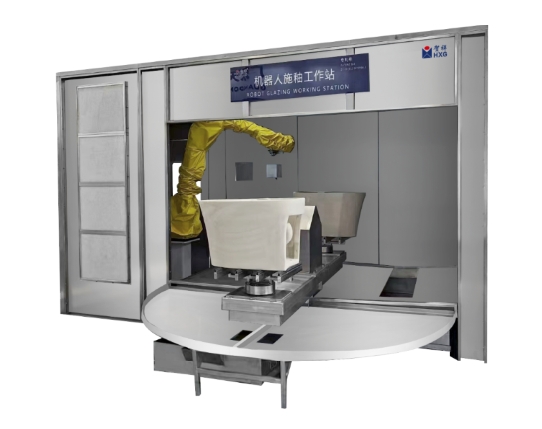
Transitioning to mechanized systems completely resolves these quality dilemmas. Implementing an advanced Robotic Glazing Line shifts the process to exact science. Modern systems feature 6-axis industrial articulation with a reach exceeding 2000mm. These machines maneuver spray nozzles into the tightest internal siphons with absolute precision.
Engineers program the fluid pressure, atomization air, and fan patterns via offline software. This means the robot applies an exact 1.5mm to 2mm uniform layer of glaze to every single piece without stopping production to teach new trajectories. This level of control drastically reduces pinholes and micro-cracks.
Metric | Manual Glazing | Robotic Glazing Line |
|---|---|---|
Glaze Thickness | Highly variable, prone to pooling | Strictly controlled to exact millimeters |
Material Waste | Up to 30% lost to overspray | Under 5% with automatic recovery systems |
First-Pass Yield | 70% to 80% on complex shapes | Consistently exceeds 95% |
Worker Safety | High exposure to silica dust and fumes | Zero exposure, fully enclosed booths |
Capital expenditure on heavy industrial equipment must deliver an aggressive financial return. The economic benefits of modernizing a ceramic plant extend far beyond headcount reduction.
First-Pass Yield is the ultimate metric of success. Every product rejected after the kiln represents a total loss of energy and raw materials. By utilizing comprehensive Sanitary Ware Automation, factories minimize human touchpoints. Eliminating handling smudges and ensuring flawless spray applications causes structural defects to plummet. A higher yield translates directly to more sellable inventory generated from the exact same amount of raw clay.
Raw glaze materials formulated with specialized frits carry a heavy price tag. Manual spraying is notoriously inefficient. Precision machinery utilizes targeted spray paths and fluid dynamics to apply material only where structurally necessary. Over a single fiscal year, the massive reduction in wasted clay slip and expensive glazes directly lowers the unit cost of each produced piece.
Transitioning an established manual factory requires meticulous planning. Plant managers must approach implementation strategically to ensure minimal disruption to daily operations.
Before procuring equipment, conduct a rigorous audit of your assembly lines. Identify the exact bottlenecks draining profitability. Determine if the manual glazing department causes the highest post-firing defect rate. Analyze cycle times to pinpoint precisely where modernization will deliver the fastest financial return.
Sanitary ware manufacturing is not a one-size-fits-all industry. When selecting a Glazing Robot, look beyond basic specifications. Demand offline programming capabilities so your engineers can map new toilet designs without halting the production line. Ensure the system includes automatic gun flushing to save hours of manual cleanup time between color changes. The End-of-Arm Tooling must be custom-engineered to handle the unique weights and fragilities of your specific product catalog.
Machinery does not completely remove the human element. It simply shifts the nature of the work. Current staff possess intuitive knowledge of how clay behaves. Invest in comprehensive training so these veteran workers can navigate Human-Machine Interfaces, adjust programming parameters, and conduct routine preventative maintenance. This fosters a highly skilled workplace culture.
Relying exclusively on grueling manual labor is an obsolete business model. Rising labor costs, alarming injury rates, and unpredictable quality force the industry to evolve. Modern ceramic machinery solves these critical operational bottlenecks head-on.
Strategically integrating automated systems drastically improves worker safety, optimizes raw material usage, and guarantees a mathematically flawless final product. Upgrading your facility is a definitive step toward future-proofing your business. Evaluate your current production lines today. For plant managers ready to eliminate defects and scale output, exploring tailored automated solutions from trusted industry leaders like HXG Machine is the critical next step.
No. Advanced machinery eliminates back-breaking labor and hazardous repetitive tasks, but human oversight remains critical. Factories require skilled personnel for machine programming, complex quality control inspections, preventative maintenance, and overall plant management. The goal is to elevate workers from physical laborers to technical supervisors.
The physical footprint varies based on production capacity, but modern automated systems are highly compact. A single robotic cell frequently fits into the exact square footage previously occupied by multiple manual spraying booths while delivering a significantly higher daily output.
Yes. Advanced industrial robots feature 6-axis articulation. This multi-directional movement allows the robotic arm to reach deep into complex curves, internal rims, and narrow trapways that are notoriously difficult for human hands to coat evenly.
The timeline depends on production volume and local labor rates. However, the majority of sanitary ware factories achieve a full return within 18 to 36 months. This rapid payback is driven by massive reductions in labor overhead, decreased material waste, and a drastic drop in defective products.
Modern systems are engineered for harsh industrial environments. Routine maintenance involves daily checks of the spray gun nozzles, weekly lubrication of the robotic arm joints, and periodic calibration of the fluid pressure sensors. Automated gun flushing features handle the daily cleaning, significantly reducing manual upkeep.
Absolutely. The core advantage of programmable logic controllers is adaptability. Engineers can save hundreds of different recipes in the system software. By adjusting the fluid pressure, atomization air, and robot speed via the control panel, the machinery instantly adapts to varying slip viscosities and distinct glaze densities.


