
Views: 0 Author: Site Editor Publish Time: 2026-09-14 Origin: Site


Consumers today demand more bathroom designs than ever before. Manually glazing different shapes causes frustrating production delays. It also wastes expensive raw materials. A flexible robotic automation system solves this exact issue on the factory floor. In this comprehensive guide, you will discover how modern automated equipment effortlessly handles complex sanitary ware. You will see exactly how these systems transition between drastically different product designs without missing a beat.
Before diving into the technical mechanics, the following table summarizes the core mechanisms. These features allow automated systems to process diverse sanitary ware designs efficiently on a high-mix production floor.
Capability | Technical Mechanism | Operational Benefit |
|---|---|---|
Smart Recognition | RFID tags and 3D vision systems | Automatically identifies incoming SKUs to load the correct program without human intervention. |
Specialized Programming | Offline Programming software | Allows plant engineers to design glazing paths for new models without stopping current production. |
Hardware Flexibility | Multi-axis arms and servo-turntables | Reaches hidden curves of diverse sanitary ware, adjusting angles dynamically. |
High ROI | Precise trajectory and flow control | Reduces glaze waste, eliminates manual application errors, and ensures uniform thickness. |
Walk onto any modern ceramics shop floor today, and you will notice a drastic shift. We are no longer running single-model batches for weeks at a time. Recent industry trend analyses highlight a stark transition in the sanitary ware sector. Driven by a booming housing renovation market and the rise of smart home integration, manufacturers face unprecedented demand for geometric diversity. Consumers expect immense variety in shape, size, and finish. Market data shows a significant increase in SKU variety over the last five years, pushing traditional manufacturing methods to their breaking point.
For plant managers, this translates directly into a high-mix, low-volume production nightmare. Facilities must handle dozens of different SKUs on the same line daily. Compounding this challenge is a severe global shortage of skilled manual glazers. This constant fluctuation puts immense pressure on traditional setups. Frequent changeovers are required, and manual operations simply struggle to accommodate these shifts efficiently.
Relying on manual labor for high-mix product lines introduces severe operational bottlenecks. Picture the actual factory floor. Human workers face significant physical fatigue when wrestling with heavy, 40-kilogram wet clay models throughout an exhausting eight-hour shift. Furthermore, this inevitable fatigue leads to inconsistent glaze thickness. Operators miss spots in hard-to-reach plumbing traps. You will always see noticeable quality variations between the morning and night shifts.
What this means practically is quite simple. When switching from a straightforward pedestal basin to a complex smart toilet with internal channels, operators must mentally and physically recalibrate their spraying technique. This manual transition slows down the line. It spikes the defect rate. Implementing flexible automation bridges this gap completely. It provides the tireless consistency of robotics paired with the extreme adaptability required for modern product catalogs.
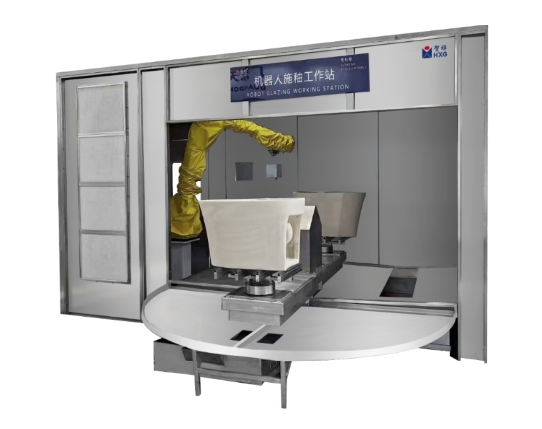
In a modernized facility, seamless model switching begins before the green ceramic piece even enters the spray booth. Industrial Radio Frequency Identification tags are typically embedded directly into the casting molds, transport pallets, or conveyor carriers. As a specific sanitary ware model approaches the active glazing zone, a reader scans the tag. It instantly transmits the data to the central Programmable Logic Controller.
The controller immediately identifies the SKU. It then communicates with the robot to load the exact spraying trajectory file required for that specific piece. Specifically, this digital handshake occurs in mere milliseconds. It ensures absolutely zero delay in the continuous production cycle.
While tracking tags tell the system what the product is, 3D vision systems are absolutely necessary to confirm exactly where it is. Even with precise conveyor mechanisms, a heavy clay toilet might sit slightly off-center on the turntable. To counteract this reality, advanced laser scanners and 3D cameras capture point-cloud data of the incoming ceramic piece.
The system then compares this real-time physical dimension data against the stored CAD model. If the piece is misaligned by even a few millimeters, the vision system calculates the spatial offset. It dynamically adjusts the robot coordinate system. In addition, this real-time calibration ensures the spray gun maintains the exact required standoff distance from the ceramic surface. This completely prevents the uneven coating that plagues manual operations.
Historically, programming an industrial robot meant taking the machine offline. An engineer had to manually guide the arm point-by-point using a teach pendant. In today high-mix environment, this level of downtime is completely unacceptable. Modern systems bypass this hurdle by utilizing advanced Offline Programming software.
Engineers can now import 3D CAD models of newly designed toilets and basins into a virtual simulation environment. They generate, refine, and test the robot exact movements directly on a computer screen. Once the path is fully optimized for fluid dynamics and collision avoidance, the code is pushed over the network. Consequently, the factory can program new SKUs while the machine continues to glaze existing models. This maximizes Overall Equipment Effectiveness.
Managing hundreds of different product variations requires a robust software architecture. A modern Robot Glazing Cell utilizes an advanced interface equipped with an intuitive recipe management system. Each recipe contains highly specific parameters for a single model. This includes the trajectory, turntable rotation speed, atomization air pressure, and exact fluid flow rate.
When a factory needs to switch production from a batch of standard basins to a batch of elongated toilets, the transition is effortless. The operator simply calls up the corresponding recipe. The entire transition takes seconds. It completely eliminates the mechanical adjustments and test-spraying traditionally required during manual line changeovers.
Toilets are widely considered one of the most difficult sanitary ware items to process. This is due to their internal plumbing channels like S-traps and P-traps. These narrow, winding channels must be coated perfectly. Flawless coverage ensures sanitary waste clearance and prevents blockages once installed in a residential home.
To solve this engineering challenge, a dedicated Toilet Glazing Machine utilizes specialized extended nozzles paired with the extreme articulation of a 6-axis robotic arm. The robot inserts the angled nozzle deep into the trap. It then executes a precise rotational withdrawal that coats the internal geometry evenly. This complex twisting maneuver is virtually impossible for a human operator to replicate with the same consistency shift after shift.
The visible surfaces of a toilet demand aesthetic perfection and functional smoothness. This is particularly true for the upper rim and the main bowl. Advanced programming techniques are employed to manage the fluid dynamics of the wet glaze as it hits these curved ceramic surfaces.
Specifically, the robot is programmed to maintain a strict perpendicular angle to the surface at all times. It seamlessly adjusts its travel speed as it moves from the wide bowl up to the narrow rim. By overlapping spray passes at mathematically calculated intervals, the system prevents drips, runs, or thin spots. This uniform coverage is absolutely critical for meeting stringent quality control standards.
Basins present a completely different set of geometric challenges compared to toilets. Modern basin designs often feature wide, flat bottoms contrasted with sharp, sheer vertical edges. A highly calibrated Basin Glazing Machine must adapt its spray characteristics accordingly to ensure a flawless finish.
The robotic system dynamically adjusts the spray fan width and atomization pressure on the fly through proportional valves. For wide flat bowls, the fan is widened for efficient rapid coverage. However, as the robot arm approaches a sharp modern edge, the fan narrows. The travel speed increases slightly to prevent glaze accumulation. This level of finesse ensures aesthetic perfection across wildly varying basin architectures.
One of the most critical quality control points in basin manufacturing is the management of functional apertures. Excess glaze buildup in overflow holes and main drain cutouts during the high-temperature firing process can alter final dimensions. This renders the basin incompatible with standard metal plumbing fixtures.
To mitigate this risk, the controller is programmed with highly localized trajectory adjustments. It navigates carefully around these sensitive zones. The system can momentarily reduce fluid flow or alter the spray angle. This ensures these holes receive adequate coverage for waterproofing without the risk of dimensional distortion caused by heavy glaze pooling.
The core component enabling multi-model flexibility is the 6-axis industrial robotic arm. Unlike rigid older automation systems, a 6-axis arm provides six distinct degrees of freedom. It mimics the complex yaw, pitch, and roll movements of a human arm, but with absolute mathematical repeatability.
This kinematic flexibility is essential when reaching under the rim of a toilet or angling into the deep bowl of a basin. Furthermore, these arms are designed specifically to operate in harsh particulate-heavy environments. They utilize pressurized and sealed joints featuring IP67 protection ratings. This prevents highly abrasive zircon-heavy glaze materials from damaging internal gears and servo motors.
The robotic arm does not work in isolation. A highly efficient cell pairs the arm with a synchronized servo-controlled turntable. This turntable essentially acts as the seventh and eighth external axes of the system. It handles payloads easily exceeding 100 kilograms.
As the robot applies the glaze, the turntable spins, tilts, and elevates the heavy ceramic piece. This dual-motion system is coordinated by a single master controller. It ensures the piece is always presented at the optimal angle to the spray gun. The turntable does all the heavy lifting. It rotates the product to expose the back and underside, which drastically reduces manual handling and shortens the cycle time per unit.
To handle both massive commercial toilets and delicate residential basins on the exact same line, advanced cells incorporate Automatic Tool Changers. Different sanitary ware models simply require different fluid delivery parameters and physical nozzles.
If the current product requires a wide-fan spray gun for a large surface area, the robot uses its primary tool. If the next product in the queue is a toilet requiring a specialized internal trap nozzle, the machine adapts instantly. The robot arm moves to a docking station, drops the primary gun, and locks onto the specialized lance in seconds. This hardware adaptability ensures the machine is always using the optimal physical tooling.
Choosing the correct automation setup requires a hard look at your shop floor data. If your facility produces high volumes of a single standard toilet, a rigid fixed-gun automation line might suffice. However, if you are processing thirty different SKUs per week, you absolutely need the 6-axis flexibility and recipe management software discussed above.
Plant engineers should evaluate the physical footprint available. Modern flexible cells are remarkably compact compared to massive traditional spray lines. Look for systems that offer integrated overspray recovery and closed-loop fluid control. These features directly impact your return on investment by slashing raw material waste.
Industrial glaze is a massive operational expense for ceramics manufacturers. In manual spraying operations, transfer efficiency is notoriously low. It often hovers around forty to fifty percent. The remainder is lost as overspray, which must be collected and filtered.
A robotic system strictly controls this transfer efficiency. By executing exact repeatable spray paths and triggering the spray gun only when precisely aligned with the target surface, factories can push transfer efficiency above seventy percent. This reduces glaze waste drastically. Additionally, automated reclaim systems integrated into the booth capture overspray much more efficiently when spray patterns are predictable.
In high-mix production, variability is the ultimate enemy of profitability. Human error during manual changeovers or simple physical fatigue leads to high defect rates. You will frequently see pinholes, crawling, or uneven coloration.
Automating the process ensures that the hundredth piece glazed on a Friday afternoon receives the exact same micrometer thickness as the first piece glazed on a Monday morning. By standardizing the application process across all models, manufacturers see a dramatic increase in their First-Pass Yield. Fewer products require manual touch-ups, re-glazing, or scrapping.
In traditional manufacturing, switching a line from producing pedestal basins to smart toilets could take hours of mechanical adjustment. Nozzle cleaning and test spraying cripple throughput.
With automated recipe management and tracking integration, this changeover time is reduced to mere seconds. The robot instantly adapts its kinematics, fluid parameters, and turntable synchronization without requiring human intervention. This rapid operational agility maximizes factory uptime. It allows manufacturers to adopt just-in-time production strategies and respond swiftly to changing market demands.
Automating your production line is the definitive engineering solution to high-mix manufacturing challenges. A flexible robotic system handles various sanitary ware models effortlessly. It bridges the gap between mass production and custom design demands. By leveraging smart sensors, 6-axis kinematics, and reliable offline programming, factories can eliminate costly changeover downtime entirely.
Beyond simple flexibility, this technology drastically reduces glaze waste and improves overall product quality. It ensures mathematically perfect application thickness every single time. Upgrading to automated equipment is no longer just a luxury. It is a smart empirical business decision for any ceramics facility looking to stay competitive. Visit https://www.hxgmachine.com today to evaluate your factory needs. Explore our high-performance equipment and request a custom ROI analysis for your specific production line.
With advanced tracking integration and automated recipe management systems, the software transition is nearly instantaneous. It occurs in milliseconds. The physical transition typically takes only the few seconds required for the new product to index into the glazing booth. This results in zero mechanical downtime for the production line.
No, stopping production is not necessary. Modern robotic systems utilize Offline Programming software. Plant engineers can import the 3D CAD file of the new sanitary ware model into a computer simulation environment. Once the program is finalized and tested virtually, the recipe is simply pushed to the machine central controller via the factory network.
Yes. A well-engineered robotic cell is designed for maximum kinematic versatility. By leveraging dynamic software recipes, automatic nozzle changers, and a programmable multi-axis turntable, the exact same 6-axis robotic arm can effectively glaze a flat wide basin and subsequently navigate the complex internal plumbing traps of a heavy toilet.
Ceramic manufacturing involves natural raw materials, meaning slight dimensional variations and clay shrinkage are inevitable. To account for this, the system employs parametric programming paired with 3D vision sensors or laser scanners. The controller uses real-time coordinates to apply micro-adjustments to the programmed trajectory, ensuring optimal standoff distance.
Manual spraying typically yields a transfer efficiency of forty to fifty percent due to human fatigue and inconsistent angles. An automated robotic cell utilizes precise fluid control and optimized perpendicular trajectories. This pushes the transfer efficiency up to seventy or even eighty percent, resulting in massive raw material savings over an annual production cycle.
Selection depends heavily on your daily throughput and SKU mix. For high-mix environments, a compact cell with a 6-axis arm and a dual-station servo turntable is ideal. It allows an operator to load a green piece on one side while the robot glazes on the other. Consulting with experienced automation integrators will help determine the exact payload and reach requirements based on your heaviest ceramic models.


