
Views: 0 Author: Site Editor Publish Time: 2026-09-12 Origin: Site


Are high defect rates quietly eroding your daily production yields? Walking the floor of a traditional sanitary ware plant, the sight of warped green bodies and unpredictable shrinkage is all too common. In this high-stakes manufacturing environment, traditional low-pressure methods often cause uneven walls and severe structural stress during the firing process. Plaster molds degrade rapidly over time. This leaves operators constantly battling shifting dimensions, which ultimately bleeds your factory's profitability.
To address these systemic engineering flaws, the industry has shifted toward a far more robust standard. We will explore how automated systems fundamentally alter the physics of slip casting, replacing natural capillary action with controlled hydraulic force. By upgrading your production line, you guarantee uniform, high-quality sanitary ware during every single manufacturing cycle.
Precision Engineering: Automated pressure control ensures uniform clay slip distribution, drastically reducing structural weak spots in modern sanitary ware.
Superior Mold Lifespan: Upgrading to engineered polymer materials eliminates rapid degradation, ensuring dimensional accuracy over tens of thousands of cycles.
Automated Consistency: Removing manual handling variables standardizes the entire process, locking in exact demolding procedures, moisture content, and cycle times.
Bottom-Line Impact: Improved forming consistency directly translates to higher production yields, resulting in fewer pre-kiln rejections and a highly measurable Return on Investment.
In the context of modern ceramic manufacturing, pressurized casting is an automated industrial setup designed to form green bodies by injecting liquid clay into porous molds under elevated mechanical force. This methodology entirely replaces low-pressure capillary slip casting, which relies solely on the natural and highly unpredictable suction of dry plaster.
Traditional casting is essentially a waiting game. It relies on natural capillary action where dry plaster slowly absorbs water from the liquid slip. Consequently, this natural absorption is inconsistent, depending heavily on ambient factory humidity and the specific age of the mold.
Market analysts tracking global ceramic manufacturing trends note a definitive pivot. Driven by stringent environmental regulations and escalating skilled labor costs, modern facilities are aggressively phasing out these slow, energy-wasting traditional methods. The industry standard is rapidly moving toward fully automated, closed-loop pressure systems. By operating at elevated pressures, mechanical force actively pushes water through microporous mold walls. This completely removes environmental variables from the forming equation, aligning perfectly with modern demands for energy efficiency, reduced carbon footprints, and automated precision.
A specialized Toilet Bowl HPCM is engineered specifically to handle the complex, multi-part mold structures required for intricate sanitary ware like one-piece and two-piece designs. Stepping onto a modernized factory floor, you immediately notice the sheer scale of the robust hydraulic clamping systems holding massive mold segments tightly together under extreme force. Alongside these heavy-duty clamps, an automated slip injection system pumps liquid clay into the cavity while a synchronized compressed air and water drainage system expertly manages moisture extraction.
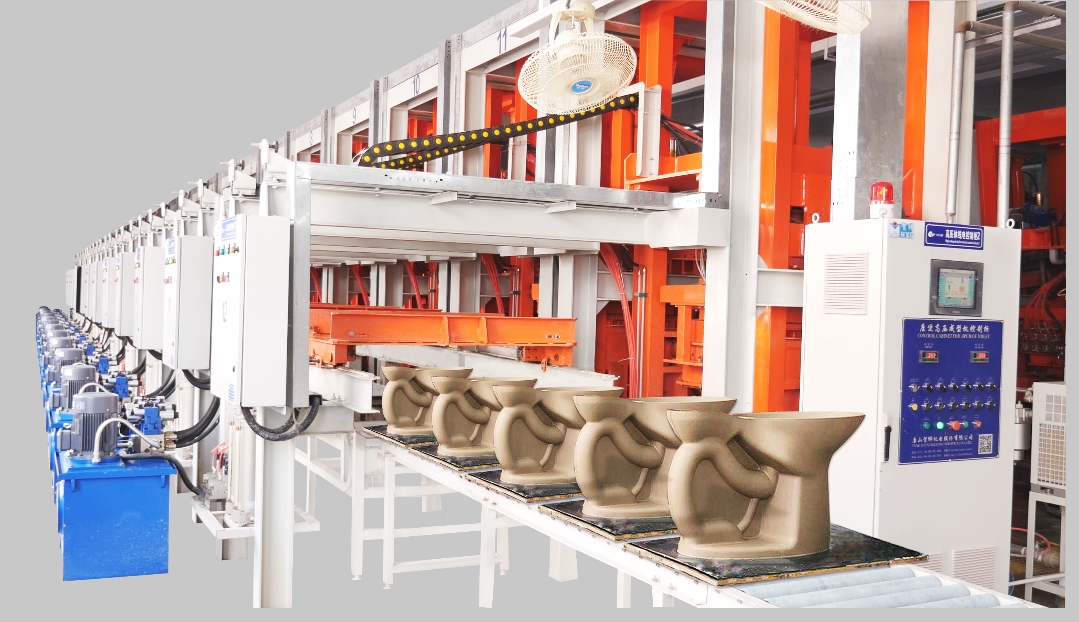
The primary function of pressurized casting is to strip away the physical variables that lead to unpredictable product quality. Plant engineers achieve this through strict, mathematical control over fluid dynamics.
Injecting slip under 10 to 15 bar of pressure fundamentally changes how the material behaves. Instead of pooling lethargically, the liquid clay aggressively reaches every intricate corner, internal trap, and rim simultaneously. This immediate, forceful distribution prevents the formation of hidden internal air bubbles. Because air pockets are a primary cause of structural failure in ceramics, compressing the slip eliminates these hidden voids. The result is a perfectly uniform wall thickness throughout the piece, statistically eliminating weak spots during the compaction phase.
From a practical standpoint, moisture control is the most critical factor before a green body ever reaches the kiln. Uneven moisture causes differential shrinkage, which inevitably leads to severe warping. High-pressure machinery solves this by utilizing advanced compressed air technology. After the slip forms the desired wall thickness, pressurized air is injected to squeeze excess water out of the clay evenly. Operators no longer have to guess if a piece is dry enough based on touch. The green body retains a highly uniform moisture gradient, ensuring it shrinks perfectly evenly during the firing process.
The sheer force of high-pressure environments means traditional materials are entirely obsolete. The effectiveness of the machinery is intrinsically linked to advanced polymer chemistry.
Anyone who has managed a traditional casting plant knows the messy reality of plaster. It degrades rapidly, creates excessive dust, and loses fine internal detail after just 80 to 100 casts. As the plaster expands and wears down, the resulting products become heavier and dimensionally inaccurate, leading to severe fitting issues down the line. Transitioning to Resin Mould Casting solves this degradation completely. Utilizing highly durable engineered polymer materials, a single mold can withstand immense hydraulic clamping forces for 30,000 to 40,000 cycles. The first cast is identical to the thirty-thousandth.
These advanced molds are not solid blocks of plastic. They feature a complex, manufactured microporous structure. Millions of microscopic holes measuring just a few microns across allow water to pass through while securely retaining the solid clay particles. Because this network is precisely engineered, water is expelled uniformly across the surface, preventing localized soft spots that cause slumping. Following each cycle, compressed air back-flushes the pores, keeping the microscopic network clean and prepped for the next cast.
Human intervention when handling heavy, wet clay is a leading source of defects. Modernizing your operations means taking the product out of vulnerable human hands during its most fragile state.
Manual handling often leaves finger marks or accidentally deforms the soft clay as workers struggle to pry heavy molds apart. A modern Water Closet Casting Machine utilizes advanced robotics and synchronized air-pressure release systems to bypass these risks entirely. When the cycle finishes, a microscopic air cushion is injected between the mold and the clay, gently releasing the green body without suction tearing. Automated mechanical arms then support and transport the piece, keeping the pristine surface untouched.
Traditional casting schedules are notoriously difficult to predict. They fluctuate based on the weather outside and the physical fatigue of the workers inside. This variability makes quality control a nightmare. By contrast, an automated system locks in exact, unchangeable parameters. Every single piece undergoes the exact same slip injection, pressure hold, and demolding timeline, creating a predictable and highly repeatable production output.
For factory managers and production engineers, transitioning away from manual benches provides massive operational and financial leverage. The contrast between the two methodologies is stark when looking at the data.
Production Metric | Traditional Plaster Casting | High Pressure Casting Machine |
|---|---|---|
Cycle Time | 8 to 12 hours | 15 to 25 minutes |
Mold Lifespan | 80 to 100 casts | 30,000 to 40,000 casts |
First-Grade Yield | Typically 70% to 75% | Consistently 90% to 95% |
Labor Requirement | High manual labor | One operator per multiple machines |
Fewer pre-kiln rejections mean less wasted clay, water, and energy. Exponentially faster cycle times translate to higher daily output per square meter. This powerful combination leads to significantly higher first-grade pass rates, ensuring that the initial capital investment is quickly offset by continuous daily savings.
Not all automated systems are manufactured to the same exacting standards. Selecting the right equipment requires a careful evaluation of engineering specifications to ensure seamless integration into your current operations.
Buyers must prioritize the robust nature of the hydraulic systems. Complex multi-part molds require substantial pressure to prevent mold leakage during the 15-bar slip injection phase. Industrial-grade machines typically feature 60 to 120 tons of clamping force. If this force fluctuates even slightly, slip will leak through the joints, ruining the cast and potentially damaging the equipment. Look for heavy-duty steel frames and premium hydraulic valves because pressure stability is non-negotiable.
Upgrading your machinery should not force you to reinvent your material science. Choose a system that adapts to your factory's specific clay slip rheology. The equipment must handle your preferred slip viscosity and feature precise temperature control. Because slip is usually heated to around 35 to 40 degrees Celsius for optimal flow, the machine must maintain this temperature to ensure consistent filtration rates through the micropores.
Consider a mid-sized sanitary ware facility producing complex two-piece designs. Relying on traditional plaster, they struggled to maintain a 75 percent first-grade yield, constantly battling base warping and inconsistent weights. After transitioning to an automated high-pressure system, the results were transformative.
By dropping cycle times from 12 hours to just 20 minutes and practically eliminating scrap waste, these factories are perfectly positioning themselves to meet both stringent environmental regulations and aggressive market demand. The reduction in physical footprint also allows facilities to scale up production without needing to construct new factory buildings.
Achieving perfect consistency in complex sanitary ware manufacturing is nearly impossible when relying on the variable nature of manual plaster methods. High-pressure systems solve these persistent production headaches by combining immense hydraulic force, precise moisture control, and highly durable engineered molds.
This machinery represents the undeniable future of scalable, high-quality ceramic production. If uneven walls, high scrap rates, and long cycle times are cutting into your margins, it is time to evaluate your current defect rates. Partnering with an industry-leading manufacturer to upgrade your lines will transform your factory floor from a variable environment into a model of modern, predictable efficiency. To explore specific machine configurations, technical parameters, and customized mold solutions tailored to your production line, visit HXG Machine to secure your competitive advantage today.
While traditional plaster casting can take anywhere from 8 to 12 hours per cycle, a high-pressure system typically completes a forming cycle in just 15 to 25 minutes. This timeframe depends heavily on the internal complexity of the specific design being manufactured.
Plaster molds generally degrade and lose dimensional accuracy after 80 to 100 casts, leading to inconsistent products. In stark contrast, engineered microporous polymers can withstand 30,000 to 40,000 casts without losing their precise internal dimensions.
Yes. Modern high-pressure casting machines are specifically engineered with advanced multi-part mold clamping systems. They often utilize 4 to 7 separate mold parts, allowing them to easily accommodate intricate internal traps, siphons, and rims inherent in one-piece designs.
While you can generally use standard sanitary ware slip, it is highly recommended to optimize the material's temperature and viscosity. Manufacturers usually heat the slip slightly to improve its flow dynamics and maximize the filtration rate through the micropores.
Absolutely. The vast majority of firing defects, such as cracking and warping, are directly caused by uneven wall thickness and varying moisture content within the green body. A high-pressure machine mathematically eliminates both of these variables, dramatically increasing your first-grade pass rate straight out of the kiln.
Because the process operates continuously and vertically, it eliminates the need for sprawling rows of plaster molds drying over several hours. A single automated machine can replace dozens of traditional casting benches, freeing up massive amounts of factory floor space for other operations.
Installing these systems requires industrial-grade utilities. Facilities must provide a stable high-voltage electrical supply for the hydraulic pumps, a robust compressed air system for mold back-flushing and moisture extraction, and a clean water supply for the automated mold washing sequences.


