
Views: 0 Author: Site Editor Publish Time: 2026-09-13 Origin: Site


Step onto any traditional ceramics factory floor. The air is heavy with humidity. You will immediately hear the constant hiss of pressurized spray guns. Operators work tirelessly to coat intricate clay bodies with a viscous slurry. Achieving a perfectly even finish on complex sanitary ware—toilets, bidets, and intricately shaped washbasins—is an engineering nightmare.
Manual spraying inevitably leaves uneven spots. Hard-to-reach areas like siphon traps and inner rims are notorious for poor coverage. This inconsistency directly causes high defect rates. Scrapped products and wasted materials eat away at plant profitability. We need a definitive, industrial-grade solution to this manufacturing bottleneck. By examining the mechanics and fluid control software behind modern automation, you will learn exactly how robotic systems maintain flawless uniformity and why they are indispensable for competitive ceramic production.
Precision Control: Advanced kinematics and trajectory software maintain strict distance and angle parameters. This ensures consistent glaze thickness across the most complex geometric curves.
Waste Reduction: Closed-loop fluid delivery systems optimize transfer efficiency. Minimizing overspray drastically reduces annual raw material expenditures.
Higher First-Pass Yields: Removing human fatigue lowers the incidence of pinholes, crawling, and uneven finishes. Products exit the kiln ready for sale.
Seamless Integration: Modern setups feature offline programming and dynamic conveyor tracking. Plants can integrate these machines into existing lines with minimal downtime.
Objective ROI: Measurable reductions in labor costs and post-kiln rejections facilitate a structured, rapid return on investment.
Global manufacturing is undergoing a massive operational shift. The ceramics sector is feeling this acutely. Recent industry data highlights a sharp decline in available skilled manual sprayers. Younger generations are actively avoiding hazardous, dust-heavy environments. Simultaneously, environmental regulations regarding raw material waste and silica dust exposure are tightening across the globe.
This dual pressure forces plant managers to rethink fluid application entirely. Automation is no longer just a capacity upgrade. It is a critical survival mechanism. Facilities adopting advanced robotic glazing are seeing immediate competitive advantages. They stabilize their daily output while drastically reducing their carbon footprint and raw material consumption.
Manufacturing high-quality ceramics requires strict adherence to physical and chemical tolerances. The application of glaze is the most critical stage. Flat tiles are simple. Sanitary ware presents unique geometric hurdles. These products feature deep cavities, sharp internal curves, undercut rims, and hidden siphon traps. Applying a uniform layer of liquid glaze across these multidimensional surfaces is a complex fluid dynamics problem.
Historically, factories relied on human operators to manually spray glaze. This method introduces unavoidable variability into the production line. A standard industrial spray gun fully loaded with glaze is heavy. Operators must manipulate this cumbersome equipment continuously throughout their shift. They twist their wrists and bend their backs to reach awkward interior angles.
Physical fatigue leads to application inconsistencies. To achieve a uniform coating, the spray nozzle must remain at a constant distance—typically 20 to 30 centimeters. It must also maintain a precise perpendicular angle to the surface. As human arms tire, the angle deviates. The travel speed of the gun fluctuates. This physiological limitation makes it impossible for even the most skilled worker to maintain strict micron-level uniformity across hundreds of pieces per day.
Inconsistent glaze application destroys profit margins. Glaze thickness directly impacts the thermal expansion and contraction of the ceramic body inside the kiln, where temperatures exceed 1,200°C.
Thick glaze in recessed areas pools up. This causes crawling, blistering, or structural cracking during firing. Conversely, thin glaze on sharp edges results in dry spots and a rough finish. These pieces fail rigorous quality control standards. Scrapped products waste the massive amounts of energy and raw materials used to create them. They also incur disposal costs, severely impacting the overall profitability of the facility.
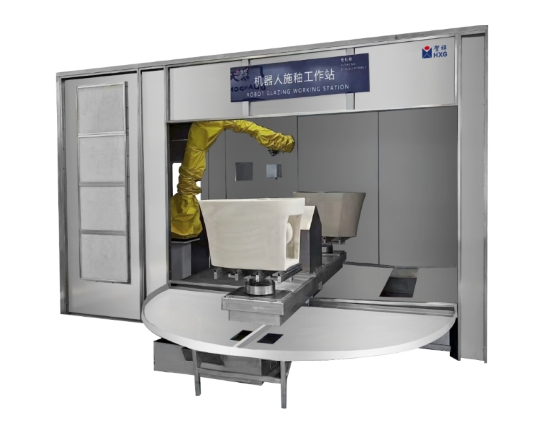
To overcome ergonomic and technical limitations, the ceramics industry has turned decisively to automation. A modern industrial robot is not merely a mechanical arm. It is a highly integrated ecosystem of hardware and software designed to execute precise fluid application. Understanding how these machines outperform human operators requires a close look at their core components.
The foundation of a highly efficient Robot Glazing Cell is the 6-axis articulated arm. This configuration provides six degrees of freedom. The machine replicates the complex movements of a human wrist, shoulder, and elbow, but with mathematical precision and zero fatigue.
Multi-axis flexibility is crucial for sanitary ware. The robotic arm maneuvers the spray nozzle deep inside narrow toilet bowls. It angles precisely beneath overhanging rims. It tracks smoothly along the sweeping exterior curves of a modern washbasin. Industrial robotic arms are engineered with high repeatability. They return to exact spatial coordinates with a margin of error of less than 0.1 millimeters.
Mechanical movement is only one half of the equation. Accurate fluid delivery is the other. Automated systems utilize specialized spray guns connected to closed-loop fluid control networks. These systems continuously monitor and regulate atomization air pressure and glaze flow rate in real-time.
Mass flow controllers and precision diaphragm pumps ensure the exact volume of glaze is delivered to the nozzle at any given millisecond. If glaze viscosity shifts slightly due to ambient temperature changes, the system automatically adjusts fluid pressure to compensate. This dynamic regulation prevents the sudden appearance of drips or dry spots that plague manual operations.
In a high-volume production environment, sanitary ware pieces constantly move down a conveyor belt. To apply glaze accurately without stopping the line, the machine must know the exact position and orientation of each piece.
High-definition 3D cameras scan the incoming product. They identify the specific model and its exact coordinates on the workstation. The software dynamically adjusts the pre-programmed trajectory to align perfectly with the physical object. This sensor-driven adaptability ensures that slight misalignments on the conveyor do not result in misdirected spray patterns.
The operational cycle of an automated glazing line is a meticulously orchestrated sequence. To fully appreciate how uniformity is maintained across complex curves, we must break down the process from programming to maintenance.
Precision begins long before the machine is powered on. Engineers utilize sophisticated offline programming software to map out the trajectory. By importing exact 3D CAD models of the sanitary ware, programmers simulate the entire glazing process in a virtual environment.
The software generates a Tool Center Point path. This keeps the virtual spray nozzle at the optimal distance and an exact 90-degree angle to every single contour. Because this programming is done offline, it never interrupts active production. Once optimized for uniform coverage, the data file is uploaded directly to the controller.
During the actual cycle, synchronization between movement speed and fluid output is critical. A flat exterior surface requires a vastly different application dynamic than a tight internal curve.
The control system seamlessly ties the velocity to the fluid flow rate. When the robotic arm accelerates over a large flat area, the fluid control system proportionally increases the glaze output. This maintains a consistent micron-level thickness. When the arm slows down to navigate a complex siphon, the flow rate is instantly reduced. This dynamic synchronization prevents glaze from pooling in recesses.
Nozzle clogging is a common cause of unevenness. Ceramic glaze is a dense suspension of minerals and frit. It dries quickly and easily obstructs the fine orifices of an air-atomizing spray gun.
Automated machines mitigate this risk through programmed self-maintenance. Between each cycle, the robot moves to a designated purge station. It executes a rapid flush of the nozzle using pressurized water and air. This clears any residual glaze before it can calcify, ensuring the spray pattern remains perfectly symmetrical for every piece.
Transitioning from manual labor to an automated infrastructure represents a significant operational shift. Factory managers base this decision on objective, measurable improvements in production metrics.
Ceramic glaze is a massive recurring expense. In manual operations, transfer efficiency—the percentage of sprayed glaze that actually adheres to the product—is notoriously low. It often hovers around 40 percent. The remainder is lost as overspray.
Automation drastically improves transfer efficiency. The machine optimizes the spray angle, maintains the correct standoff distance, and triggers fluid flow only when perfectly aligned with the target surface. Precise, localized spraying makes it much easier to capture and reuse overspray. This leads to raw material savings amounting to tens of thousands of dollars annually.
To justify the capital expenditure, engineering teams must look at the raw data comparing manual processes to robotic integration.
Performance Metric | Manual Glazing | Robotic Glazing |
|---|---|---|
Glaze Thickness Tolerance | High variance across shifts | ± 0.1mm consistency |
Transfer Efficiency | 30% - 45% | 65% - 80% |
First-Pass Yield | Typically 75% - 85% | Consistently 95%+ |
Production Speed | Decreases with operator fatigue | Constant high-speed output |
Occupational Safety | High exposure to silica dust | Zero direct exposure |
Not all robotic systems are engineered equally. When evaluating equipment for a ceramics facility, procurement teams must look beyond basic specifications. You must assess the industrial features that ensure long-term reliability in a harsh factory setting.
A sanitary ware plant is a brutal environment for sensitive electronics. The atmosphere inside a glazing booth is filled with high humidity and airborne abrasive particulates.
When specifying an Automatic Glazing System, engineers must demand specific industrial ratings. The robotic wrist and arm must be rated IP67 minimum. They must be fully protected against dust ingress and withstand high-pressure water jets. Standard robots will fail within months. Look for internally routed fluid hoses and pressurized robot jackets to protect mechanical components from the abrasive ceramic slurry.
A sophisticated robot is only valuable if the factory floor staff can operate it. The transition to automation should not require a factory to hire software engineers. The Human-Machine Interface must be intuitive.
Leading systems feature recipe management software allowing users to select pre-programmed parameters for different toilet models with a single tap. Crucially, look for systems supporting visual path editing. Operators must be able to modify the trajectory slightly to account for minor variations in clay shrinkage without rewriting raw code.
Facilities rarely build a new line from scratch. You must integrate new technology into existing infrastructure. A highly capable setup must possess advanced conveyor tracking.
The control system must interface directly with the factory conveyor encoders. Whether the line uses a stop-and-go indexing system or a continuously moving belt, the machine must synchronize its coordinate system with the moving target. This applies a uniform coating without requiring the conveyor to halt.
Maintaining uniform glaze on complex sanitary ware is a multidimensional challenge. It is nearly impossible to scale efficiently using manual labor. The geometric complexities of toilets and washbasins combined with human physical limitations inevitably lead to wasted materials and high defect rates.
By integrating a Sanitary Ware Glazing Robot, ceramic manufacturers transform an unpredictable bottleneck into a repeatable science. With 6-axis mobility, dynamic fluid control, and advanced offline programming, these systems guarantee perfect coverage. In a highly competitive market facing labor shortages, adopting automated glazing is a strategic necessity for safeguarding product quality and driving long-term profitability.
Generating a new trajectory takes surprisingly little time with modern offline programming software. Engineers import the 3D CAD model and simulate the glazing path in a virtual environment within a few hours. This happens on a separate computer, so it never stops current factory production. Once perfected, the program uploads directly to the controller.
Yes. Modern systems are highly adaptable. Facilities utilize RFID tags on conveyor pallets or 3D vision systems. As a product enters the booth, sensors instantly identify whether it is a washbasin or a specific toilet model. The controller automatically switches to the corresponding spray program in a fraction of a second.
While manual spraying typically achieves 30 to 45 percent transfer efficiency, a properly calibrated robotic system achieves between 65 and 80 percent. This massive improvement is due to precise distance control, optimal perpendicular spray angles, and triggering the spray only when exactly aligned with the target surface.
Industrial glazing robots utilize closed-loop fluid control systems equipped with mass flow meters and precision pumps. If the glaze viscosity changes due to ambient factory temperatures, the sensors detect the flow rate variation instantly. The system automatically adjusts the pump pressure in real-time to ensure the exact required volume of glaze reaches the nozzle.
Daily tasks typically involve checking fluid lines for leaks and ensuring the automated nozzle flushing system operates correctly. Periodic maintenance includes lubricating the joints, inspecting the protective IP67 jackets for wear, and calibrating the vision sensors. Manufacturers provide clear maintenance schedules to ensure maximum uptime.
Absolutely. Material savings are the fastest driver of ROI for these systems. By drastically reducing overspray and capturing waste efficiently in water-wash booths, factories typically see material savings of 15 to 30 percent compared to manual spraying. This translates to thousands of dollars saved annually on raw ceramic frit.
Eliminating glaze defects and reducing raw material waste requires industrial-grade precision. If your facility is struggling with high rejection rates, inconsistent quality, or labor shortages, it is time to evaluate an automated solution. Visit HXG Machine to explore high-performance robotic glazing lines tailored specifically for the complex geometries of modern sanitary ware.


