
Views: 0 Author: Site Editor Publish Time: 2026-09-11 Origin: Site


A single firing flaw ruins days of meticulous work. In ceramic manufacturing, transitioning from fragile greenware to a structurally durable bathroom fixture is arguably the most unforgiving stage of production. Factories need precise temperature control to succeed. The slightest thermal inconsistency compromises an entire batch. Poor equipment causes massive profit losses daily, turning raw materials and expensive labor into unsellable scrap. In this comprehensive guide, we will break down how to strategically plan, select, and optimize your sanitary ware machinery. You will learn how to maximize yield, safeguard profit margins, and future-proof your facility.
Key Takeaways:
Selecting the right kiln architecture depends strictly on production volume and product mix.
Continuous systems deliver high-capacity output. Batch systems offer flexibility for custom runs.
Rigorous factory layout planning reduces greenware handling errors and improves ambient energy efficiency.
Investing in advanced thermal processing machinery lowers long-term operational costs and guarantees environmental compliance.
Avoiding common capacity-planning mistakes saves factories millions in future retrofitting expenses.
Recent market analyses reveal a definitive shift toward decarbonization and automation across heavy ceramic manufacturing. Global emission mandates are tightening rapidly. Consequently, forward-looking facilities are pivoting away from legacy fossil-fuel setups. The industry is moving toward hybrid firing technologies. Production engineers now demand fuel flexibility, opting for hydrogen-ready burners or electric-gas hybrid systems. These innovations act as a strategic hedge against volatile natural gas markets.
Furthermore, data-driven manufacturing is no longer optional. Seamless Supervisory Control and Data Acquisition integration allows operators to monitor real-time firing curves. Plant managers can now predict maintenance needs and prevent disastrous batch failures before they occur. Factories failing to adopt these smart thermal technologies will soon struggle to remain cost-competitive.
Before diving into equipment specifications, plant managers must understand the complex thermodynamics at play. When firing toilets, basins, and bidets, the clay body undergoes a rigorous physical and chemical transformation known as vitrification. During this high-temperature phase, silica melts. It fills the microscopic pores of the ceramic body, creating a watertight and structurally rigid product. Simultaneously, the applied glaze melts into a smooth, hygienic glass layer.
Your thermal equipment carries the ultimate responsibility for product quality. Inconsistent temperature zones or turbulent airflow within a Firing Machine inevitably lead to catastrophic defects. You will see structural cracking, surface pinholes, or dimensional warping. The caliber of your thermal machinery directly dictates your first-choice yield. This yield—the percentage of flawless products passing quality control on the first attempt—is the ultimate driver of manufacturing profitability.
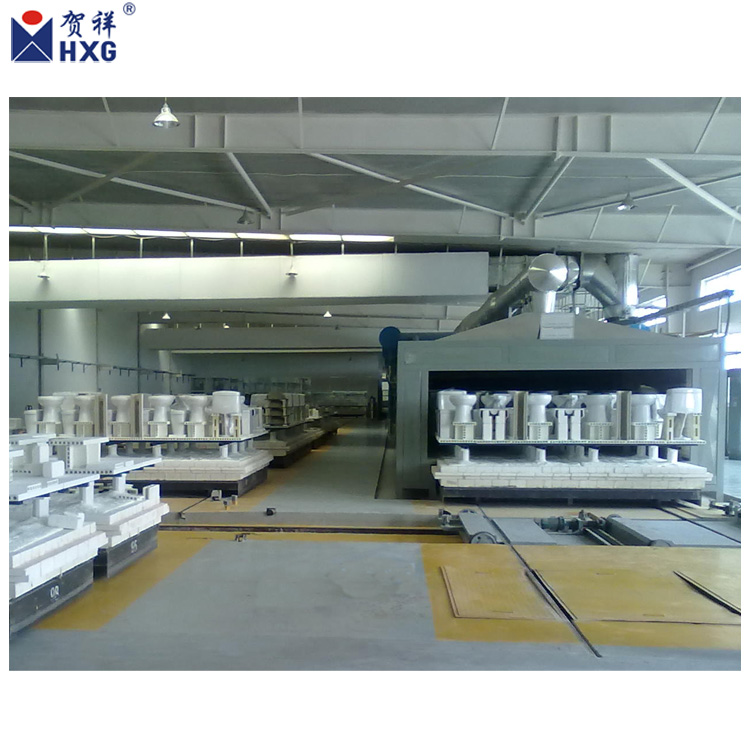
Selecting the appropriate thermal infrastructure requires aligning equipment capabilities with specific production targets. You must weigh volume demands against product diversity. Let us break down the primary architectures used in modern plants.
Architecture Type | Best Suited For | Energy Efficiency | Production Flexibility |
|---|---|---|---|
Tunnel Kiln | High-volume, continuous 24/7 production | Excellent at scale | Low |
Shuttle Kiln | Specialty items, custom colors, oversized pieces | Moderate to Low | High |
Roller Hearth | Flat sanitary ware like shower trays | Very High | Moderate |
Picture a continuous line of heavily laden kiln cars. Each carries dozens of freshly glazed washbasins, slowly advancing through a meticulously calibrated thermal tunnel. A high-capacity Tunnel Kiln operates continuously, pushing ceramics through distinct pre-heating, firing, and cooling zones. For large-scale factories, this remains the undisputed gold standard. Because the structural zones remain at constant temperatures, no thermal energy is wasted heating up and cooling down the refractory walls.
In contrast, a shuttle kiln operates on a batch-firing basis. Workers load a stationary chamber and seal the doors. The entire internal environment heats up and cools down according to a programmed curve. This setup is ideal for complex architectural pieces requiring unique firing profiles. However, shuttle kilns consume significantly more fuel per unit produced due to the repeated thermal cycling of the insulation.
When evaluating a Ceramic Sanitary Ware Kiln, production engineers must scrutinize specific parameters. A generic machine will not suffice for complex bathroom fixtures. You need precise engineering metrics to ensure long-term viability.
Multi-zone temperature control is absolutely non-negotiable. Modern sanitary ware features complex geometries with varying wall thicknesses. Heating a thick toilet rim at the same rate as a thin basin wall causes internal stress fractures. Look for equipment offering a tight cross-sectional temperature tolerance, ideally within ±2°C at peak firing temperatures of 1200°C to 1250°C.
Specifically, top-tier industrial models feature internal widths ranging from 2.5 to 3.6 meters. This wide cross-section accommodates oversized smart toilets and double-sink vanities. Furthermore, advanced burner technology is critical. High-velocity burners ensure uniform heat distribution, while automated draft controls maintain optimal kiln pressure. These integrated systems ensure your firing cycle—typically lasting 12 to 24 hours—runs flawlessly day and night.
Procuring top-tier equipment solves only half the equation. Integrating it physically into your factory floor requires rigorous spatial engineering. The footprint of a continuous firing system extends far beyond the main chamber. Planners must calculate the necessary length and width for the main tunnel while allocating extensive space for staging areas, loading platforms, and unloading zones.
Material flow dictates operational efficiency. You should design factory layouts to create a seamless, short-distance transition from automated glazing lines directly to the kiln cars. Minimizing the transport distance of unfired greenware drastically reduces handling damage. In addition, engineers must carefully plot the logistical loop for car return tracks. A poorly designed return system forces workers to manually maneuver heavy cars, slowing down production and increasing workplace hazards. Finally, heavy thermal machinery generates intense ambient heat. Ensure your facility's roof height and industrial ventilation systems are robust enough to dissipate this thermal load safely.
Capital allocation for thermal processing equipment represents a massive portion of your overall budget. Miscalculations during procurement lead to structural bottlenecks, high defect rates, and excessive operational costs. Factory owners must approach selection with a rigorous, engineering-first mindset.
One of the most frequent engineering oversights is compromising on the cooling zone. In ceramic manufacturing, the cooling phase is just as critical as the heating phase. As sanitary ware transitions from peak temperatures back to room temperature, the quartz in the clay body undergoes a sudden volumetric change. This quartz inversion typically occurs around 573°C.
If a factory attempts to accelerate production by shortening the cooling cycle, the resulting thermal shock exceeds the tensile strength of the ceramic. This causes "dunting"—microscopic or visible cracks in the finished toilets. Fixing this post-installation is extraordinarily expensive. Therefore, ensure your cooling zone is mathematically proportioned to your specific product mass.
Another major mistake is ignoring future scalability. Purchasing equipment that precisely matches today’s targets without factoring in a five-year growth trajectory is a strategic error. If market expansion demands larger product dimensions and your internal kiln width is too narrow, you will face a severe bottleneck. Always evaluate modular expansion capabilities during the procurement phase.
The transition toward sustainable manufacturing is a core driver of cost competitiveness. As global energy prices fluctuate, factories operating the most thermally efficient machinery will dominate the market.
A state-of-the-art Waste Heat Recovery system is the most impactful energy-saving upgrade available. In continuous operations, the cooling zone generates substantial volumes of clean, hot air. Instead of venting this air, a recovery system captures it using insulated ductwork and heat exchangers. This thermal energy is then redirected to the drying rooms. By utilizing waste heat for greenware drying, factories can entirely eliminate independent gas burners in their drying chambers, reducing total thermal energy consumption by up to 30%.
Furthermore, modern factories are shifting toward advanced Silicon Carbide kiln furniture. Traditional cordierite supports are heavy and absorb massive amounts of fuel during every cycle. Silicon Carbide components are significantly thinner and lighter, yet offer superior mechanical strength. Reducing furniture weight drastically improves the product-to-furniture ratio, ensuring your fuel is spent heating actual washbasins rather than support structures.
Purchasing industrial firing equipment extends far beyond the initial price tag. Investors must transition from a lowest-bidder mindset to a comprehensive Total Cost of Ownership analysis. The operational lifespan of this machinery spans decades.
You will notice a wide variance in initial Capital Expenditure among suppliers. A budget-tier system might seem financially attractive on paper. However, these savings are an illusion quickly erased by higher Operating Expenditures. Budget equipment utilizes lower-grade refractory insulation and less precise burner technologies. Consequently, they consume significantly more natural gas per kilogram of fired product.
Fuel costs represent one of your largest ongoing expenses. A premium machine with a higher initial cost but a 15% better fuel efficiency rating typically pays for its own price difference within the first 36 months of operation. When calculating your 10-year model, factor in maintenance costs, refractory brick replacements, and the cost of unplanned downtime. A slight 2% improvement in your first-choice yield rate generates massive revenue increases, turning a heavy capital expense into a highly profitable asset.
The firing process is the undeniable heart of your sanitary ware factory. Transitioning raw clay into high-value bathroom fixtures requires precision, reliability, and strategic foresight. Proper planning balances immediate capacity needs with intelligent layout design and rigorous energy efficiency standards.
Choosing the right machinery is a foundational business strategy. It ensures long-term profitability and environmental compliance in a fiercely competitive market. Do not leave your most critical production stage to chance. Consult with experienced engineering experts to design a custom thermal solution tailored exactly to your product mix.
To explore advanced thermal solutions tailored to your production needs, visit HXG Machine. By investing in our reliable, high-efficiency equipment today, you secure the operational agility needed to dominate the sanitary ware industry tomorrow.
The optimal firing temperature for standard ceramic sanitary ware typically falls between 1,180°C and 1,250°C. The exact target temperature depends highly on the specific chemical composition of the clay body and the glaze formulation. At these peak temperatures, vitrification occurs. This physical transformation ensures the final toilet or basin achieves zero water absorption, maximum structural durability, and a glossy finish. Precise temperature uniformity across the entire internal profile is mandatory to prevent warping.
A standard firing cycle for sanitary ware in a continuous industrial system generally ranges from 12 to 24 hours. This extended duration accommodates the complex thermal dynamics of thick-walled ceramics. The cycle includes gradual pre-heating to evaporate residual moisture, a soaking phase at peak temperature for uniform vitrification, and a highly controlled slow cooling phase to prevent thermal shock.
Cracking, often referred to as dunting or thermal shock, usually occurs during the cooling phase. Around 573°C, the quartz within the ceramic body undergoes a sudden volumetric change known as quartz inversion. If the cooling zone lowers the temperature too rapidly, the internal stress exceeds the material's tensile strength, resulting in structural cracks. Poor temperature uniformity during the heating phase can also cause stress fractures in items with varying wall thicknesses.
A tunnel kiln is a continuous system where products move on cars through permanently heated thermal zones, making it highly energy-efficient and ideal for 24/7 mass production. A shuttle kiln is a batch system where products remain stationary inside a sealed chamber that heats up and cools down entirely for each cycle. Shuttle kilns offer high flexibility for custom or oversized items but consume significantly more fuel per unit.
No, a batch shuttle kiln cannot be retrofitted into a continuous firing system. They rely on fundamentally different thermodynamic principles and structural architectures. However, purchasing a batch kiln is not a wasted investment. Large-scale factories frequently retain these units alongside their primary continuous systems. They use them for specialized architectural pieces, product development testing, or overflow capacity during peak demand.
When engineered by a reputable manufacturer and subjected to rigorous maintenance, high-quality industrial firing equipment operates efficiently for 15 to 25 years. The heavy steel superstructure lasts decades. However, internal components like refractory brick linings, ceramic fiber insulation, and burner nozzles are consumable items. Factory operators must strictly adhere to maintenance protocols and replace degraded insulation periodically to maintain optimal fuel efficiency.


