
Views: 0 Author: Site Editor Publish Time: 2026-09-14 Origin: Site


Automation has completely revolutionized the ceramics and sanitary ware industries. It introduces unprecedented levels of speed and precision to the factory floor. Yet, unexpected downtime remains a massive threat. A sudden halt can cost manufacturers thousands of dollars in a single afternoon. Picture this scenario on the production line. A broken automated manipulator ruins a full day of output. Meanwhile, clogged fluid nozzles and obscured optical sensors waste highly valuable, precisely mixed raw materials. Plant managers must build a proactive, structured maintenance routine to prevent these catastrophic bottlenecks.
In this comprehensive guide, you will discover practical, hands-on upkeep steps ranging from daily cleaning rituals to long-term mechanical care. By implementing these strategies, you ensure your automated infrastructure delivers a flawless return on investment and stable daily output.
Daily Cleaning is Non-Negotiable: Maintaining a pristine application environment and clear atomizing equipment prevents the vast majority of common coating defects and fluid blockages.
Preventative Mechanical Upkeep: Regularly inspecting, cleaning, and lubricating the robotic manipulator significantly extends the operational lifespan of your equipment.
Fluid and Air Pressure Monitoring: Achieving a consistent glaze flow requires strict daily monitoring of fluid delivery lines and compressed air outputs.
Software and Sensor Calibration: Keeping the optical vision systems clean ensures precise application and minimizes raw material waste.
Partnering with Experts: Choosing a reliable manufacturer ensures your facility has uninterrupted access to durable replacement parts and technical support.
Looking at current industry trends, the ceramics manufacturing sector is rapidly shifting toward predictive maintenance powered by the Industrial Internet of Things. Modern facilities increasingly rely on smart sensors to monitor motor vibrations and current draws in real-time. This data allows engineering teams to predict mechanical failures before they halt production. Is this digital shift enough? The short answer is no.
Even with cutting-edge artificial intelligence diagnostics, the physical reality of ceramic production remains incredibly harsh. Ceramic glazes are intensely abrasive. They are formulated as complex suspensions of silica, alumina, and mineral fluxes. If left to settle, these materials act like liquid sandpaper. They aggressively degrade internal seals, precision valves, and mechanical joints. Consequently, no digital alert system can replace the physical necessity of executing a structured upkeep schedule. Technology guides the maintenance team, but wrench-in-hand execution keeps the line moving.
In the industrial ceramics sector, transitioning to automated production lines represents a massive capital expenditure. Operational directors inherently understand that the true return on this investment is not measured merely in speed. It is measured in unyielding reliability. Maintaining your equipment is not just a housekeeping chore. It is a fundamental operational strategy that directly impacts the bottom line, overall equipment effectiveness, and long-term profitability.
Data from automated manufacturing facilities consistently indicates that preventative maintenance is exponentially more cost-effective than reactive repairs. When a machine is pushed to the point of catastrophic failure, the financial penalties compound rapidly. You pay premium rates for expedited replacement parts and emergency technician labor. Furthermore, you absorb the heavy cost of halted production lines and idle floor workers. Shifting to a proactive mindset mitigates wear and tear. This ensures that the mean time between failures remains high and unexpected downtime is virtually eliminated.
The primary reason manufacturers adopt automation is to eliminate human error and achieve perfect consistency. In contrast, a neglected machine simply cannot deliver uniform results. If fluid lines become partially restricted by hardened slurry, the resulting application will be noticeably uneven. A meticulously maintained system guarantees uniform thickness across complex geometries. This reliability directly reduces the scrap and rework rate, ensuring every batch passes strict quality control before entering the firing kiln.
Stable daily operations rely heavily on the habits formed by operators at the beginning and end of every single shift. Implementing a highly actionable routine serves as the primary line of defense against equipment degradation.
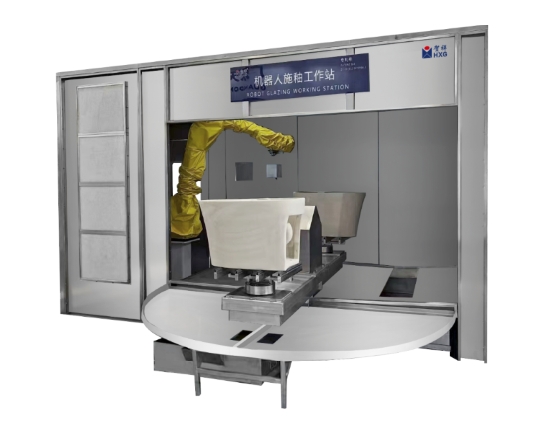
The immediate environment in which the automation operates must be kept pristine. The Glazing Booth is specifically engineered to capture overspray. However, if this wet material is allowed to accumulate and dry, it creates a hazardous workspace. When wet overspray hardens overnight on the floor grating, it transforms into a concrete-like crust. Removing it requires aggressive chipping, which risks damage to the infrastructure. Dried flakes can also become airborne and settle on freshly coated products, causing pinholes during the firing process.
At the end of every shift, operators must perform a thorough, low-pressure washdown of the interior walls, water curtains, and structural bases. All residual material should be systematically guided into the collection sump or recycling system. No wet slurry should remain on the manipulator base.
Perhaps the most critical daily task is the management of the fluid delivery infrastructure. Ceramic suspensions settle incredibly fast when not in active motion. If left stagnant in the hoses overnight, heavy particulate matter separates from the water. This creates dense blockages that can rupture lines or destroy pump diaphragms upon the next morning startup.
Operators must execute a systematic flushing protocol to prevent this. This involves shutting off the main supply valve and running warm, clean water through the entire plumbing system. The flush must continue until the liquid exiting the nozzle runs crystal clear. Additionally, operators should verify that all fluid pressure gauges drop back to zero. This confirms that no residual pressure is trapped dangerously in the lines.
The atomization mechanism is the beating heart of the coating process. Even if the robotic arm executes its programmed trajectory with absolute perfection, a compromised nozzle will instantly ruin the product. Dedicating meticulous attention to this component is essential for maintaining high-yield production.
Because the applied materials contain highly abrasive frits, the internal components of the Spray Gun are subjected to extreme friction. Specifically, the fluid needle and the micro-machined nozzle orifice endure constant wear. Over time, this friction enlarges the opening, leading to excessive material output and sputtering atomization.
Operators must carefully remove the air cap and fluid nozzle at the end of the production day. These delicate parts should be soaked in a specialized ultrasonic cleaner to dissolve semi-hardened residues. Never resort to using metal wire brushes or hard steel picks to clear a stubborn clog. Doing so will permanently scratch and deform the precision-machined orifice. Instead, utilize soft-bristled nylon brushes or approved wooden picks. Visually inspect the needle for grooving. Replace the needle and nozzle as a matched set if you detect any asymmetrical wear.
A stable automated cell requires exact pneumatic settings to achieve the correct fan geometry. If the incoming compressed air pressure fluctuates, the coating may spit or apply in a heavy texture. Before production begins each morning, operators should perform a test spray on a scrap ceramic body. Measure the width and density of the pattern to ensure it matches documented baseline standards. A distorted pattern indicates either a partial blockage in the air cap horns or a severe imbalance in the pneumatic supply.
While fluid dynamics dictate the quality of the coating, the mechanical robotics dictate the positioning and repeatability. The complex assembly of servo motors, harmonic drives, and precision bearings requires systematic care to function flawlessly under continuous industrial strain.
Industrial manipulators utilize sophisticated gearboxes that endure thousands of repetitive cycles per shift. To maintain smooth movements, these joints must be properly and consistently lubricated. A lack of lubrication drastically increases internal friction. This elevates motor temperatures and accelerates eventual mechanical failure.
Maintenance teams must adhere strictly to the lubrication schedule defined by the equipment manufacturer. This involves injecting the precise grade of synthetic grease into the designated zerk fittings on each axis of the Handling Robot. It is vital not to over-lubricate. Excessive grease can blow out internal pressure seals or leak into the external environment. Always wipe down the grease fittings before application to avoid pushing abrasive factory dust directly into sensitive gear assemblies.
In systems where the equipment physically manipulates the raw ceramic product, the end-of-arm tooling represents a critical failure point. Dropping an unfired ceramic piece destroys the product and can cause severe collateral damage to the surrounding infrastructure.
Inspect pneumatic gripper pads weekly for early signs of wear, surface cracking, or a loss of friction. Actively listen for the faint hiss of micro-leaks in the air lines. Ensure that the clamping force is calibrated perfectly. Excessive pressure will crush the raw clay, while insufficient pressure will result in catastrophic slippage during high-speed rotational transfers.
Beyond the superficial daily cleaning rituals, ensuring stable production requires deeper mechanical inspections. Dedicated maintenance technicians typically execute these critical tasks rather than frontline operators.
Maintenance Strategy | Impact on Production Uptime | Component Lifespan | Overall Cost Efficiency |
|---|---|---|---|
Reactive Repair | High risk of sudden, prolonged line stoppages. | Severely reduced due to abrasive wear and tear. | Very poor. High costs for emergency parts and labor. |
Proactive Upkeep | Maximum uptime with predictable scheduled stops. | Significantly extended through proper lubrication. | Excellent. Eliminates material waste and rush fees. |
The fluid delivery infrastructure operates under constant stress from both high pneumatic pressure and abrasive internal wear. Monthly deep-dives should focus intently on the structural integrity of the entire plumbing system.
First, inspect all flexible fluid and air hoses for signs of external chafing or brittleness. Hoses routed directly along the moving robotic arm are particularly susceptible to fatigue from constant bending. Next, address the inline strainers designed to catch large agglomerations of unmixed material. Technicians must open, remove, and thoroughly scrub these filters weekly to prevent flow restriction. Finally, closely monitor the pneumatic double-diaphragm pumps. Listen for irregular pulsation or inspect the exhaust mufflers for fluid bypass, which is a clear indicator of a ruptured internal diaphragm.
Modern automated systems rely heavily on an array of optical sensors, laser scanners, and vision cameras to identify product positioning. The primary enemy of these delicate electronics is airborne mist.
If a fine layer of mist obscures a camera lens, the software may miscalculate its spatial trajectory. This leads to damaging collisions or severe overspray. Lenses must be carefully wiped down weekly using approved optical-grade wipes and mild solvents. Furthermore, the vision system spatial awareness should be recalibrated monthly using standardized physical targets. This ensures the digital coordinates remain perfectly synchronized with the physical workspace.
Even with a rigorous schedule in place, operational anomalies will occasionally occur. When production halts, plant managers and operators need to diagnose and resolve issues swiftly using a structured root-cause analysis approach.
When finished products emerge from the kiln exhibiting dry spots or pooling, the root cause almost always lies within the fluid delivery process.
To diagnose this, first verify the fluid pressure at the main pump and the atomization air pressure at the nozzle. Inspect the fluid tip and air cap for microscopic blockages. Next, check the specific gravity and viscosity of the current batch. If the mixture is too thick, the equipment simply cannot atomize it properly. Finally, review the programmed path speed. If the arm moves too rapidly over a complex curved geometry, the resulting coating will be inherently too thin.
If the robotic arm shudders, vibrates audibly, or stops abruptly during its cycle, it strongly indicates a mechanical binding or electronic synchronization fault.
Begin by checking for physical obstructions or heavy accumulated buildup on the arm that might exceed the motor payload capacity. Inspect the servo motor drives and digital encoders for specific fault codes on the main control interface. Verify that all axes have been recently lubricated. Dry harmonic drives will bind and cause severe physical juddering. Additionally, ensure the heavy-duty communication cables between the main controller and the manipulator are secure and undamaged.
There comes a definitive point in the lifecycle of any industrial machinery where ongoing maintenance yields diminishing returns. Recognizing the threshold between routine upkeep and technological obsolescence is vital for strategic capital planning.
If your maintenance technicians spend more hours repairing the machine than it spends in profitable production, it is time to evaluate an upgrade. Key indicators of obsolescence include a rapidly dropping mean time between failures and the complete inability to source legacy replacement parts. Furthermore, if your current hardware cannot natively integrate with modern software for real-time data tracking, you are operating at a massive competitive disadvantage.
Transitioning to modern automation infrastructure permanently resolves legacy maintenance headaches through vastly superior engineering. Today's equipment is built from the ground up with self-diagnostic software, highly corrosion-resistant materials, and modular components designed for rapid replacement.
Investing in a state-of-the-art Robot Glazing System provides manufacturers with unmatched precision. For example, modern industrial setups feature 6-axis flexibility, IP67 protection ratings against harsh factory dust, and an impressive positioning repeatability of ±0.05mm. Advanced solutions feature highly durable enclosed servo mechanics and intuitive touch-screen interfaces that simplify complex path programming. By upgrading to these modern systems featuring automated color change capabilities and robust technical support frameworks, you ensure that your production facility remains stable and exceptionally profitable.
An automated glazing cell is a substantial industrial investment that demands a culture of proactive, relentless maintenance. Consistent, scheduled upkeep is the only proven method to prevent costly production downtime and material waste. By rigorously adhering to daily cleaning protocols, executing precise mechanical lubrication, and conducting deep-dive component checks, you protect your automation investment from the harsh realities of ceramic production. However, when repairs become too frequent and expensive, recognize that modern technology offers vastly superior efficiency. Commit to a structured maintenance routine today. When it is time to scale your production to the next level, visit https://www.hxgmachine.com to explore cutting-edge, industry-proven automation solutions designed for ultimate reliability.
The atomizing equipment must be flushed with clean water or an appropriate solvent and superficially cleaned at the end of every single production shift. This prevents suspended ceramic particles from settling and hardening inside the narrow fluid passages overnight. Beyond this daily flush, a comprehensive disassembly and inspection must be performed on a weekly basis using soft-bristled brushes.
With strict adherence to daily maintenance, proper lubrication, and scheduled component servicing, high-quality industrial robotic glazing lines can reliably operate for 10 to 15 years before requiring a major mechanical overhaul. The lifespan is heavily dependent on the abrasiveness of the materials used and how quickly worn consumable parts are replaced.
The handling unit acts as a synchronized physical bridge governed by advanced programmable logic controllers. It is typically programmed to pick up raw products from an incoming conveyor, present them directly to the active atomizers inside the booth at highly precise angles, and then carefully place the wet product onto a secondary drying conveyor.
Yes, it is entirely feasible to utilize multiple colors or different chemical formulations within the same automated cell. However, this requires a rigorous high-pressure flushing sequence of the fluid lines, pumps, and atomizers between batches. Operators must ensure the purge cycle has completely cleared the previous material, often utilizing automated color change manifolds for faster transitions.
Optimal fluid pressure typically ranges between 0.8 to 1.5 bar, depending heavily on the specific gravity and viscosity of the ceramic slurry. High-viscosity sanitary ware glazes require slightly higher pressure to maintain a steady flow rate. It is crucial to balance this with the atomizing air pressure to prevent excessive bounce-back and material waste.
Preventing material separation requires continuous, low-speed mechanical agitation inside the stainless steel supply tanks. Pneumatic or electric paddle mixers should run constantly during production and at a reduced speed during idle shifts. Additionally, employing a recirculating fluid loop ensures the slurry remains in constant motion through the hoses right up to the spray nozzle.


