
Views: 0 Author: Site Editor Publish Time: 2026-09-13 Origin: Site


Automation reduces factory labor costs rapidly. Yet, upgrading a legacy manual plant presents complex engineering hurdles. Recent industry analyses indicate a massive shift toward Industry 4.0 within the ceramics and sanitary ware sectors. Driven by a shrinking pool of skilled manual sprayers and volatile raw material prices, manufacturers are turning to automated fluid application. This stabilizes production and protects the bottom line.
Current market data shows a sharp increase in automation adoption among sanitary ware producers over the past three years. The driving force is not just labor reduction. It is the urgent need for material efficiency and strict environmental compliance. Plants relying on manual spraying face inconsistent glaze thickness and excessive overspray. Consequently, upgrading to an automated line has shifted from a luxury to an absolute survival necessity.
However, space constraints and system synchronization often cause real headaches for plant managers. Integrating advanced robotic systems requires a highly strategic plan rather than a simple plug-and-play approach. In this comprehensive guide, you will discover the critical infrastructure checks needed to ensure a smooth, profitable, and safe facility setup.
Industrial mechanical arms require a fundamentally different spatial footprint compared to human operators. A worker can naturally pivot and adjust their stance within a cramped workstation. In contrast, an automated system operates strictly within programmed geometric boundaries. Overlooking these dimensional requirements frequently leads to immediate installation bottlenecks.
The foremost metric is the equipment maximum reach, commonly known as the spherical work envelope. Production engineers must calculate the exact volume the arm will occupy at full extension. This prevents catastrophic collisions with existing factory pillars or overhead beams. For instance, a standard 6-axis sanitary ware spraying robot typically features a reach of around 2100mm to 3000mm and a payload capacity of 10kg to 20kg. Such heavy-duty specifications demand substantial floor mounting plates that consume additional square footage.
Beyond the mechanical arm, plant managers must allocate dedicated climate-controlled space for the Programmable Logic Controller cabinets. These units need specific clearances for heat dissipation. Imagine a maintenance crew trying to diagnose an electrical fault. Without adequate door clearance, a minor check turns into a major production disruption. Furthermore, cable routing demands attention. Planning for overhead trays or reinforced floor trenches protects heavy-duty communication cables from high-traffic wear and tear.
Integrating new automation means the surrounding enclosure must be appropriately sized. It cannot merely fit the raw sanitary ware. It must provide ample clearance for the complex articulation of the arm. Should the enclosure be too restrictive, collision sensors will trigger constantly and paralyze output. Technicians require unobstructed access doors to safely clean atomizers and perform mechanical checks without dismantling the entire structure.
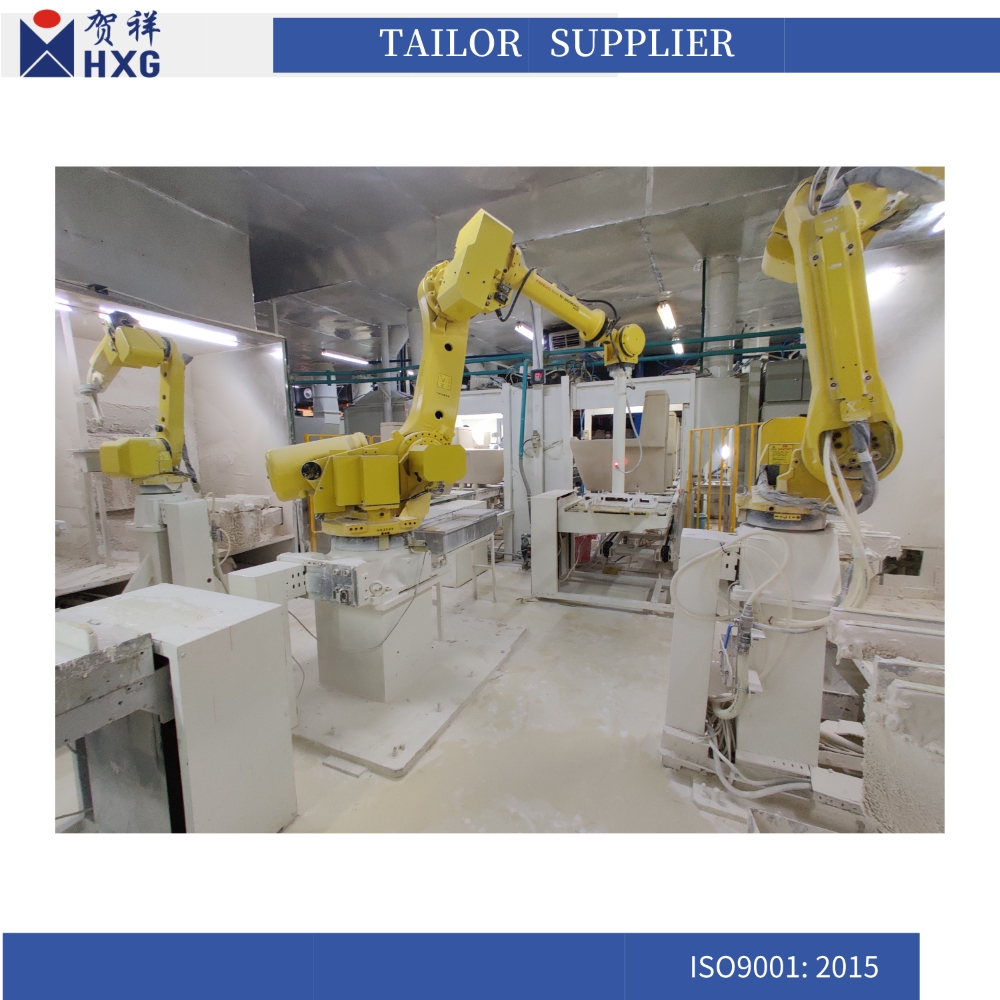
An automated sprayer is only as efficient as the infrastructure feeding it. A prevalent oversight in facility upgrades is assuming that legacy transport lines can immediately support high-speed robotic operations without modification.
For precise fluid application, the control system must know the exact coordinates of the moving product at all times. This necessitates flawless digital communication with your existing Conveyor System. Facilities typically deploy one of two strategies. These are mechanical indexing or dynamic line tracking.
Indexing forces the line to halt precisely at a designated stop. Upgrading older belts with high-precision servo motors or pneumatic stops is often mandatory here. Alternatively, line tracking permits continuous movement. Engineers must retrofit the transport belt with high-resolution encoders. These encoders stream real-time velocity data to the main controller, enabling the arm to match the speed and spray accurately on the fly.
Human workers intuitively adjust their wrist angle if a ceramic basin arrives slightly skewed. A programmed machine lacks this instinct. The payload must enter the target zone in the exact same orientation every single cycle. Custom jigs or locking fixtures are essential to secure the ware against micro-vibrations. Production teams must evaluate if current pallets can be modified with centering mechanisms or if a complete redesign is necessary to guarantee absolute stability.
Automated manufacturing environments demand exceptionally stable utilities. Minor fluctuations in voltage or fluid pressure might merely annoy a human worker. However, they will cause a robotic system to produce defective batches or trigger sudden emergency faults.
Robotic drives and their accompanying control units draw substantial electrical loads. Facility managers need to verify the availability of consistent 3-phase industrial power completely isolated from voltage spikes. Installing dedicated power conditioners or isolation transformers is frequently a non-negotiable prerequisite.
Equally vital is the pneumatic infrastructure. Automated atomizers rely on compressed air to break down the heavy liquid. This air supply must be surgically clean, dry, and regulated at a constant pressure. Even a microscopic drop of oil vapor or moisture in the lines can contaminate the finish. This causes surface defects like blistering or pinholes after firing. Upgrading to industrial-grade refrigerated air dryers and sub-micron filters is a standard pre-installation step.
Continuous operation fundamentally alters the fluid dynamics of your delivery network. The equipment requires a highly pressurized non-pulsating supply to maintain an even spray fan. Inspecting legacy diaphragm pumps and rubber hoses is critical. Older pulsating pumps inevitably cause uneven coating thickness. Transitioning to closed-loop delivery networks equipped with automated viscosity sensors ensures the atomizers receive a uniform and predictable material flow.
To help engineering teams evaluate their current readiness, below is a critical infrastructure comparison matrix for upgrading to automated spraying.
Infrastructure Area | Legacy Manual Standard | Automated Robotic Standard |
|---|---|---|
Pneumatic Air Supply | Standard shop air, basic filtration | 0.6 to 0.8 MPa, refrigerated dried, sub-micron filtered |
Fluid Pumping | Open-loop diaphragm pumps | Closed-loop steady flow with automated viscosity control |
Conveyor Positioning | Visual alignment by operator | High-resolution encoders or precision mechanical indexing |
Power Quality | Standard grid connection | Isolated 3-phase power with voltage conditioners |
Physical installation represents just a fraction of the battle. Digital integration acts as the central nervous system. It dictates how seamlessly the new equipment interacts with legacy factory architecture.
The process of linking the new asset to the master control hub is known as digital handshaking. An Automatic Robot Glazing Line must exchange continuous data streams with the central PLC. This coordinates start commands, emergency halts, and batch counting. Engineers must audit network compatibility. If the factory relies on outdated proprietary protocols, installing network gateways to translate data into modern standards like Profinet or Ethernet/IP becomes essential for perfect synchronization.
Modern high-mix manufacturing rarely runs a single product shape endlessly. To manage diverse batches, the setup must recognize specific models entering the workspace. Integrating 2D or 3D vision systems empowers the controller to identify geometries and instantly load the corresponding motion path. Before deploying these cameras, facilities must analyze ambient lighting. Harsh shadows or factory glare can severely disrupt sensor calibration and lead to costly misidentifications.
Because mechanical arms do not suffer from fatigue, they output atomized fluids at higher velocities and longer duty cycles than manual crews. This operational shift drastically alters the airborne environment inside the facility. Current industry trends emphasize sustainable manufacturing. Making material recovery a top priority helps modern plant managers reduce ecological footprints and overhead.
Managing the increased volume of overspray is a primary environmental challenge. The extraction fans within the Glazing Booth must possess the capacity to capture a continuous heavy particulate load. Engineers must calculate the required Cubic Feet per Minute to prevent silica dust from escaping into the broader workspace. Depending on the current setup, upgrading to high-capacity water wash scrubbers or advanced dry filter walls is necessary to meet strict occupational health regulations.
A massive empirical benefit of automation is precise material utilization. Yet some overspray remains inevitable. By connecting the floor drainage directly to the factory reclamation loop, plants can capture, filter, and reuse this raw material. Automated density sensors and sieves can adjust the specific gravity of the reclaimed liquid before reintroducing it to the delivery tanks. This slashes consumable costs over the fiscal year.
Replacing manual labor with kinetic industrial automation introduces entirely new categories of mechanical hazards. Safety cannot be an afterthought. It must be engineered directly into the floor plan to comply with stringent global standards like ISO 10218.
Industrial mechanical arms move with immense force. A comprehensive perimeter guarding strategy is mandatory. Heavy-duty physical fences must be bolted securely to the floor to fully enclose the dynamic reach of the equipment. Maintenance access doors require dual-channel safety interlocks that instantly sever motor power if breached.
Where the transport belt passes through the enclosure walls, physical fencing is impossible. Here, safety light curtains are deployed. These devices project an invisible grid of infrared beams. Should an operator reach through the opening, the broken beams trigger an immediate safe torque off. This halts all motion instantly to protect personnel.
Hardware safety relies heavily on human compliance. The transition from manual sprayers to systems supervisors requires structured upskilling. Personnel must master Human-Machine Interface navigation to select recipes and clear faults safely. Maintenance teams also need specialized training on flushing fluid lines to prevent curing and lubricating axes to avoid premature wear.
Integrating heavy automation is inherently disruptive. Nevertheless, strategic planning allows plant managers to upgrade their infrastructure without paralyzing factory output for extended durations.
A phased installation approach protects production quotas. Instead of a complete two-week shutdown, engineering teams can execute upgrades incrementally. Routing new air lines and electrical conduits can occur while the legacy line still operates. Erecting the enclosure and retrofitting the transport belt can be scheduled during a weekend maintenance window. Once the environment is prepped, bolting down the mechanical arm happens rapidly.
To compress the commissioning timeline further, forward-thinking facilities utilize Offline Programming software. Digital twin technology enables programmers to create a virtual 3D simulation of the entire cell. By mapping tool paths, verifying collision avoidance, and optimizing spray angles virtually, the physical on-site commissioning shifts from weeks of tedious trial-and-error to just a few days of minor calibration.
Capital expenditure on advanced manufacturing technology requires objective validation. When pre-installation checks are executed meticulously, the system achieves its performance metrics faster. This significantly accelerates the Return on Investment. Industry data shows that First Pass Yield improvements are the fastest way to recoup automation costs in modern ceramics.
The primary financial driver is the stabilization of product quality. Manual application inherently involves inconsistencies. This leads to uneven coatings, drips, and high scrap rates. A programmed machine applies exact and repeatable micron-level layers. This drastically reduces rework and the energy wasted re-firing defective pieces in the kiln. Concurrently, reallocating manual workers to higher-value quality control tasks optimizes overall operational expenditure.
Sustaining this financial return over a multi-year lifecycle demands a rigorous preventative maintenance strategy. Facilities must budget for routine servo motor lubrication, pneumatic seal replacements, and periodic calibration of vision sensors. Establishing these protocols before the equipment even arrives prevents catastrophic unplanned downtime and protects the capital investment.
The installation timeline varies significantly based on pre-installation preparation. If a facility has already upgraded its utilities, routed the necessary pneumatic lines, and cleared the floor space, physical installation and commissioning can take just 5 to 10 days. However, if major modifications to the exhaust infrastructure or material handling systems are required concurrently, the process can extend to several weeks. Utilizing offline programming drastically reduces on-site delays.
Yes, but the legacy equipment will require specific retrofitting to ensure synchronization. The control system relies on precise data to apply fluids accurately. An older continuous-motion belt must be retrofitted with high-resolution encoders so the controller can track the exact speed and position of the moving product. Alternatively, mechanical indexing stops and proximity sensors must be installed to lock the product into exact coordinates every time it enters the target zone.
In most cases, the core chemical composition of your material will not need to change. However, the physical properties such as viscosity, specific gravity, and particle size must be strictly controlled. Human operators can instinctively adjust their hand speed if they notice a batch is slightly thicker than usual. A machine cannot make these qualitative judgments. Absolute consistency in fluid density is required before it is pumped to the atomizers.
For industrial atomizers to function correctly without causing surface defects, the pneumatic system must deliver a constant pressure between 0.6 and 0.8 MPa. Furthermore, this air must pass through refrigerated dryers and sub-micron filters to remove any trace of moisture or compressor oil before reaching the robot.
Automated lines utilize continuous circulation loops. Instead of dead-end hoses where heavy particulate can settle, the fluid is constantly pumped from the delivery tanks, past the robotic atomizers, and back into the tanks. Upgrading to closed-loop systems with automated agitation ensures the specific gravity remains uniform throughout the entire shift.
Modern systems handle product variations through dynamic recipe management stored within the PLC. As a product approaches the spraying zone, it can be identified using barcode scanners, RFID tags, or vision systems. Once identified, the central control system instantly loads the corresponding motion path and fluid parameters for that specific shape. This allows the line to process mixed batches without requiring manual changeovers.
While capital costs vary based on integration complexity, most industrial manufacturing plants see a full Return on Investment within 12 to 24 months. This rapid payback is driven by a significant reduction in wasted raw materials, a decrease in labor costs associated with manual rework, and a measurable increase in First Pass Yield due to the elimination of human error.
Evaluating your facility space, legacy systems, and utility infrastructure is a critical prerequisite for modernization. Upgrading pneumatics and digital networks ensures your new equipment operates at peak efficiency, while strict safety protocols protect your workforce. By planning a phased rollout, you minimize expensive factory downtime and guarantee a much higher return on investment.
If your plant is facing high scrap rates, labor shortages, or excessive material waste, it is time to transition to intelligent manufacturing. Take the time to consult with industry experts to assess your production line. Visit HXG Machine to explore professional automated solutions, review detailed product specifications, and design the perfect robotic setup tailored to your specific operational needs.


