
Views: 0 Author: Site Editor Publish Time: 2026-09-09 Origin: Site


Downtime costs factories thousands of dollars hourly. Even the best ceramic glazing equipment breaks down eventually. Without a robust support framework, your operational profits simply vanish into thin air. In this comprehensive guide, we explore the critical services that top-tier manufacturers must provide. You will learn exactly what level of after-sales backing matters most to keep your production floor moving seamlessly.
Investing in automated production equipment represents a massive capital expenditure. However, procurement teams frequently focus entirely on the upfront hardware costs. They often neglect the long-term operational framework. The true cost of machinery is never just the sticker price. Rather, it encompasses the hidden, compounding expenses of unexpected operational downtime. When a line halts unexpectedly, factories face immediate bottlenecks. Raw materials are wasted, and shipment schedules suffer severe delays.
A standard equipment vendor simply delivers the hardware and steps away. In stark contrast, a genuine strategic partner acts as an extension of your own engineering team. This collaborative model ensures continuous lifecycle support. Such backing is absolutely vital for maintaining high Overall Equipment Effectiveness.
When evaluating proposals at the bottom of the purchasing funnel, buyers must analyze the Service Level Agreement with the exact same rigor applied to technical specifications. Consequently, a comprehensive service agreement mitigates risk and ensures highly predictable maintenance costs over the machine's lifespan.
Evaluation Metric | Equipment Vendor | Strategic Manufacturer Partner |
|---|---|---|
Relationship Focus | Transactional One-time sale | Lifecycle Continuous optimization |
Support Model | Reactive Fixes upon failure | Proactive Preventive schedules |
Downtime Impact | High Unpredictable repair times | Low Guaranteed response times |
Technical support should actually begin long before the equipment ever arrives at your loading dock. Proper pre-installation planning prevents costly structural modifications and frustrating delays during the deployment phase.
Industrial environments are inherently complex. The integration of new machinery requires precise spatial planning. A reputable manufacturer will deploy structural and systems engineers to assess your factory floor prior to finalizing the machine design. They analyze the existing workflow, material handling paths, and spatial constraints. This is particularly critical for complex, multi-station setups like a Carrousel Glazing Line. Such equipment demands a highly specific footprint to allow for safe 6-axis robotic movement, efficient loading, and unobstructed operator access.
Automated lines require specific environmental and utility baselines to function correctly. Imagine a scenario where the factory's compressed air supply fluctuates during a high-speed production run. The atomizing guns will sputter instantly. This leads to uneven coatings and hundreds of rejected pieces. To avoid this, the manufacturer must provide exact engineering specifications for infrastructure preparation. This includes:
Electrical Power: Specific voltage, phase requirements, and dedicated breaker sizing to prevent power surges.
Pneumatics: Clean, dry compressed air requirements, typically demanding a stable 0.6 to 0.8 MPa pressure, for precise spray guns and robotic actuators.
Fluid Dynamics: Consistent water supply pressure for automated cleaning cycles and glaze preparation.
Ventilation: Extraction rates required for water curtain dust collection systems to safely remove airborne glaze particulates, ensuring compliance with strict occupational health standards.
Modern manufacturing relies heavily on data transparency. The new machine’s Programmable Logic Controller cannot exist in a vacuum. Pre-installation support involves IT and automation engineers mapping out exactly how the glazing line will communicate with your facility's existing Enterprise Resource Planning or Manufacturing Execution Systems. This integration guarantees seamless data tracking for production rates and material consumption from day one.
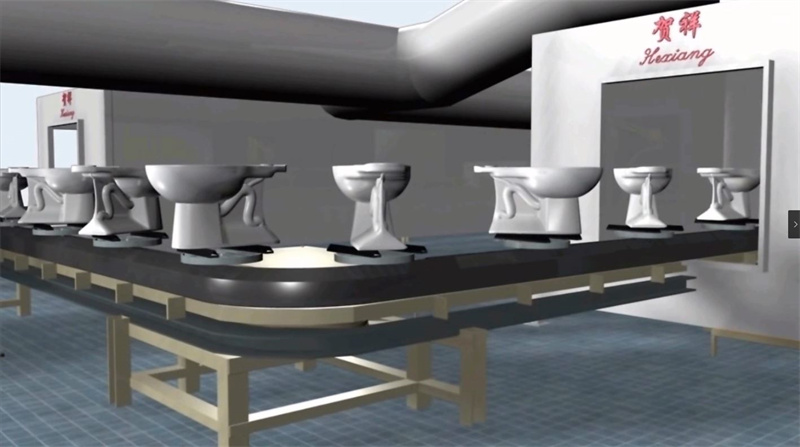
The physical installation phase is where theoretical engineering meets practical application on the factory floor. This delicate process must be heavily supported by the manufacturer's own technical staff to ensure structural integrity.
To ensure all warranties remain valid and the equipment operates safely under heavy loads, factory-certified technicians must oversee the mechanical and electrical assembly. These experts intimately understand the specific torque requirements, complex wiring schematics, and sensitive sensor alignments unique to their equipment. Relying on third-party contractors without direct manufacturer supervision frequently leads to improper assembly. This ultimately results in premature component failure.
Once fully assembled, the system requires meticulous calibration. Engineers must set up the robotic arms, diaphragm fluid delivery pumps, and atomizing spray guns. Calibration is highly dependent on the physical geometry of the products being manufactured. For example, tuning a Sanitary Ware Glazing Line requires distinct parameter adjustments to ensure uniform glaze thickness. This is especially true inside the complex hidden traps of toilets or the deeply curved basins of sinks. Engineers must fine-tune fluid pressure, fan width, and robot trajectory to eliminate runs, drips, or dry spots.
Commissioning serves as the final proving ground before official handover. The manufacturer should run extensive test batches using your actual ceramic body and specific glaze materials. This trial run proves unequivocally that the machinery meets the agreed-upon Key Performance Indicators. Engineers will measure cycle speed, glaze thickness consistency, and defect rates. The line is only considered complete when these empirical metrics perfectly align with the contractual guarantees.
Even the most robustly engineered hardware will fail if operated incorrectly by floor staff. Therefore, comprehensive, hands-on training remains a non-negotiable component of technical support.
The manufacturer must provide structured, easily digestible training for your floor staff. This covers the standard operating procedures for safely powering up the line, loading specific parameters for different ceramic models, and executing safe shutdown procedures. Safety protocols, including the rapid operation of emergency stops and light curtains, must be heavily emphasized to protect workers during high-speed operations.
Industrial ceramic glaze often contains abrasive elements like silica and alumina. It acts almost like liquid sandpaper, making fluid systems highly prone to drying and clogging. Consequently, operators must be trained on daily maintenance tasks. This includes proper techniques for cleaning delicate spray nozzles, flushing the fluid delivery lines with high-pressure water, and clearing minor mechanical jams. Empowering operators to handle these baseline tasks independently prevents unnecessary service calls and keeps the line moving.
Beyond basic daily operation, your in-house engineering and maintenance teams require deep-dive technical training. The manufacturer should provide detailed electrical schematics, pneumatic diagrams, and mechanical breakdown charts. Training your engineers to deeply understand the inner workings of the automated systems ensures long-term operational independence. It also drastically enables faster internal response times for moderate technical issues.
When operating high-volume ceramic production facilities, reactive maintenance is a highly inefficient strategy. Over time, abrasive materials cause inevitable wear and tear on fluid delivery systems, pumps, and spray nozzles. A responsible manufacturer understands this physical reality. They build a technical support infrastructure focused entirely on prevention rather than mere reaction.
Standardized manuals are rarely sufficient for complex factory environments. Top-tier technical support involves providing a customized, data-driven maintenance schedule tailored specifically to your production volume and the types of glaze you utilize. A reliable vendor will map out strict protocols for daily, weekly, monthly, and annual maintenance tasks. This proactive approach heavily mitigates the risk of catastrophic mechanical failures that can halt production for days.
Maintenance Frequency | Target Components | Required Action |
|---|---|---|
Daily | Spray guns, fluid hoses, catch basins | High-pressure water flushing, visual inspection for clogs. |
Weekly | Conveyor belts, robotic arm joints | Lubrication of moving parts, tension adjustments. |
Monthly | Diaphragm pumps, primary filters | Inspection of wear parts, replacement of filter meshes. |
Annually | Control systems, structural frames, servos | Software diagnostics, structural integrity checks, servo motor recalibration. |
Even with meticulous maintenance, wear parts will eventually fail. The true test of a manufacturer’s support capability lies in their supply chain logistics. When evaluating a vendor, procurement managers must investigate the location and inventory levels of the manufacturer’s spare parts warehouses. For critical components like specialized spray nozzles or proprietary fluid pumps for your Ceramic Glazing Machine, the manufacturer should offer a fast-track shipping guarantee. Extended delays in receiving a simple replacement part can result in tens of thousands of dollars in lost production revenue.
Beyond merely supplying parts, an authoritative manufacturer acts as an ongoing operational consultant. Premium Service Level Agreements often include bi-annual or annual on-site factory audits. During these visits, factory-certified engineers rigorously inspect the machinery, analyze historical performance data, and recommend strategic part replacements long before actual failures occur.
In modern manufacturing, physical mechanical failures only account for a portion of unexpected downtime. Software glitches, sensor misalignments, and programmable logic controller errors are equally disruptive. To address these issues rapidly, forward-thinking machinery vendors have integrated sophisticated digital support tools.
A state-of-the-art production line is no longer an isolated piece of hardware. Rather, it is a highly connected industrial asset. Reputable manufacturers equip their control cabinets with secure, industrial VPN routers. If an operator encounters an unidentifiable error code during a night shift, remote engineers can log in securely. They run real-time diagnostics, monitor sensor inputs, and identify the root cause within minutes. In many cases, software faults can be patched instantly over the internet, completely eliminating the need to wait for a traveling technician.
When physical repairs are necessary but a local technician is unavailable, visual communication bridges the gap. Leading manufacturers are increasingly utilizing Augmented Reality tools and dedicated video support platforms. By using smart glasses or standard mobile devices, on-site maintenance staff can stream real-time video of the faulty component to the manufacturer’s support center. Remote experts can then overlay digital markers on the screen, guiding the local worker step-by-step through complex mechanical repairs.
The availability of remote technology is practically useless without a dedicated team monitoring the systems. A robust service agreement should clearly define guaranteed response times based on the severity of the issue. For critical line-down situations where production is completely halted, a reliable manufacturer should guarantee a response time of under two hours, regardless of time zones or regional holidays.
Industrial automation is a continuously evolving field. The software that controls robotic trajectories, fluid dynamics, and energy consumption is frequently refined. Consequently, a machinery investment should not be static. It must continuously improve over its operational lifespan.
Human-Machine Interfaces and logic algorithms dictate the overall efficiency of the glazing process. Quality technical support includes providing free or low-cost access to software updates. These patches might introduce more intuitive interface layouts. They can also improve energy efficiency by optimizing motor standby times, or refine spray algorithms to reduce glaze waste by a few critical percentage points.
As a ceramic production facility grows, its machinery must adapt. A facility might initially purchase a basic setup but later require significantly higher throughput. A dedicated manufacturer will provide the engineering support necessary to scale the existing equipment seamlessly. Whether you need to integrate an additional robotic spraying arm or extend the drying tunnels, the manufacturer should provide the blueprints and technical backing to scale your line safely without requiring a completely new purchase.
Recent industry analysis regarding glazing line technical support reveals a massive shift from reactive repairs to predictive maintenance. Factory managers are no longer satisfied with vendors who only respond after a machine breaks down. Instead, the current industry expectation is heavily focused on IoT-enabled predictive analytics.
Modern technical support now involves analyzing real-time machine data to predict exactly when a spray nozzle will degrade or a servo motor will overheat. This allows maintenance to be scheduled during planned downtime. Furthermore, there is a growing demand for sustainability-focused software updates. Manufacturers are increasingly expected to provide ongoing remote optimizations that minimize raw glaze waste and reduce energy consumption. This aligns technical support directly with global environmental and social manufacturing goals. Smart sensors now track glaze viscosity and ambient humidity in real-time, automatically adjusting spray parameters to ensure perfect application without human intervention.
The procurement of industrial equipment requires rigorous due diligence. Decision-makers must look beyond the initial capital expenditure and deeply evaluate the Total Cost of Ownership. This cost is heavily influenced by the quality of after-sales support. To ensure you are partnering with a reliable manufacturer, utilize this objective evaluation framework during the vendor selection process:
Service Level Agreement: Do they offer a clear, legally binding agreement detailing Mean Time To Repair and guaranteed response times?
Warranty Scope: Is the warranty comprehensive, clearly defining what specific parts and labor are covered, and for how long?
Geographic Support: Do they have local or regional service hubs available, or will you have to wait weeks for international travel for physical repairs?
Training Costs: Is comprehensive, hands-on operator and maintenance training included in the initial purchase price, or is it billed as a hidden extra?
Proven Track Record: Can they provide verifiable references from other active factories currently operating their equipment under heavy, continuous production loads?
Buying industrial ceramic machinery requires careful, long-term operational planning. The hardware itself is genuinely just the beginning of the journey. Excellent technical support prevents highly expensive production downtime and keeps your supply chain intact. Always demand comprehensive, written service agreements before signing any contracts. Ultimately, a trusted machinery partner ensures your factory stays profitable, safe, and competitive. If you are looking to upgrade your production floor, choose a vendor that provides real, ongoing technical support. Explore industry-leading options and find the exact automated solutions tailored to your facility at HXG Machine today.
Most reputable manufacturers offer a standard 12-to-24-month warranty on new glazing equipment. This typically covers defective mechanical and electrical parts. Some premium manufacturers may include labor costs for the first year. It is highly recommended that procurement teams negotiate extended warranties or localized service contracts during the initial purchasing phase to secure long-term operational stability.
Yes, this is a standard requirement for high-level technical support. Top-tier manufacturers conduct comprehensive pre-installation site surveys. Their structural and electrical engineers will design custom layout plans. This ensures that modern automated lines fit seamlessly into the existing spatial constraints and infrastructure of older facility footprints without causing major operational disruptions.
This scenario highlights the critical importance of choosing a vendor that provides 24/7 remote digital support. Modern production lines are equipped with secure remote controller access. This technology allows the manufacturer’s software engineers to log into your system, diagnose error codes, and often resolve software or parameter issues from anywhere in the world, regardless of local time zones.
Initial operator training, which takes place during the on-site commissioning of the machine, is typically included in the baseline purchase price. However, follow-up training sessions for newly hired staff, or advanced mechanical and electrical maintenance courses for your in-house engineering team, usually require separate service contracts and may incur additional fees.
Because wear parts like diaphragm pumps, filter meshes, and spray nozzles degrade naturally through abrasive wear, a reliable manufacturer will maintain well-stocked regional or global spare parts hubs. Under a standard industrial service agreement, you should expect critical wear components to be dispatched within 24 to 48 hours to strictly minimize costly production downtime.
An automated line typically requires a stable three-phase electrical supply, a dedicated compressed air line delivering 0.6 to 0.8 MPa of clean, dry air, and a consistent water supply for cleaning systems. Furthermore, proper ventilation and water curtain dust collection systems are mandatory to handle airborne glaze particles and ensure a safe working environment.
Remote troubleshooting allows factory engineers to bypass travel time entirely. Through a secure industrial VPN, the manufacturer's technical team can instantly view real-time sensor data, identify logic faults, and push software patches directly to the machine. This means a problem that might take days to fix physically can often be resolved in under an hour digitally.


