
Views: 0 Author: Site Editor Publish Time: 2026-09-14 Origin: Site


Upgrading your factory floor is no longer just a luxury in the modern ceramic and sanitaryware manufacturing industry. It is a fundamental necessity for survival. Recent industry trends highlight a massive global shift toward flexible manufacturing and sustainable production. Raw material costs for frits, colorants, and opacifiers are skyrocketing. Environmental regulations around wastewater and silica dust are tightening globally. Relying on manual labor or outdated machinery is a fast track to shrinking profit margins. Manufacturers face a tough challenge. They must balance high-tech precision with relentless, continuous output.
Current market analysis reveals a clear trajectory. The era of producing tens of thousands of identical ceramic pieces for months on end is fading. Consumers and commercial buyers now demand diverse designs, forcing plants into a high-mix, low-volume production model. This shift makes equipment flexibility just as critical as raw throughput. Decision-makers often find themselves torn between two distinct automation philosophies. Do you choose the proven, high-speed continuous output of a traditional carousel system? Or do you invest in the highly adaptable, software-driven precision of a modern robot?
Making the wrong choice for your specific production floor can lead to severe bottlenecks, massive glaze waste, or a surprisingly poor Return on Investment. The solution is not a one-size-fits-all answer. This decision ultimately comes down to a careful analysis of your product complexity, your specific production volume, and your facility layout. This comprehensive guide will break down the exact operational scenarios where investing in advanced automatic glazing equipment is the smarter, more profitable choice for your plant.
Before diving into the technical mechanics and financial modeling, it is crucial to establish the fundamental conclusions of this comparative analysis. Plant managers must base their equipment procurement decisions on hard empirical data rather than fleeting industry hype. Here are the core principles to guide your evaluation.
Product Complexity Dictates the Choice: A robotic system is an absolute necessity for complex, multi-dimensional products like sanitaryware, including toilets, basins, and bidets. Conversely, rotary lines remain highly effective for simple, uniform items such as standard tableware or flat ceramic tiles.
Production Flexibility and SKU Management: Robotic cells provide rapid software-based changeovers for high-mix, low-volume production runs. Traditional continuous lines are purpose-built for high-volume, low-mix runs where product geometry rarely changes.
Material Efficiency and Waste Reduction: Advanced automation significantly reduces glaze waste. Highly programmable, precise spraying paths minimize overspray and maximize transfer efficiency.
Long-Term Return on Investment: The initial capital expenditure for a 6-axis arm may be higher. However, the operational savings in manual labor, material consumption, and defect reduction offer a rapid and substantial payback, typically within 12 to 24 months.
When evaluating factory upgrades, executives must first understand the fundamental mechanical differences between the available technologies. Both systems aim to automate the application of ceramic glaze. Yet, they approach the task using entirely different kinematic principles and engineering philosophies. Establishing this baseline is essential before analyzing real-world performance metrics.
What is a Robot Glazing Machine?
Picture a bustling factory floor. A highly advanced, programmable, multi-axis robotic arm smoothly navigates the deep internal P-trap of a toilet bowl. Designed to mimic and vastly improve upon human glazing movements, these machines utilize sophisticated servo motors and complex algorithms to execute precise spatial trajectories. Typically operating on six independent axes, the robotic arm can articulate in ways that allow it to reach internal cavities, sharp undercuts, and complex curves. Fixed machinery simply cannot access these hidden areas.
Specifically, modern robotic systems integrate seamlessly with fluid delivery networks. This allows for real-time adjustments to atomization pressure, fluid flow rates, and fan patterns. This closed-loop control ensures that the glaze thickness remains perfectly consistent across every square centimeter of the product, regardless of its geometric complexity. High-end units boast an IP67 protection rating, ensuring the delicate internal electronics remain safe from abrasive airborne silica dust.
What is a Carrousel Glazing Line?
In contrast, a rotary-style continuous machine is designed strictly for mass production. Products are loaded onto a circular indexing conveyor that moves them seamlessly past a series of fixed or mechanically oscillating spray guns. The mechanical design is relatively straightforward. It relies entirely on consistent rotational speed and constant spray pressure to coat the passing items.
This traditional equipment has been the backbone of ceramic manufacturing for decades. It excels in environments where the primary goal is maximizing throughput for identical, simple shapes. Fixed spray guns sit at predetermined angles. Consequently, this setup requires almost zero software programming. However, it completely lacks spatial adaptability. It cannot effectively handle complex, three-dimensional products with deep hidden surfaces.
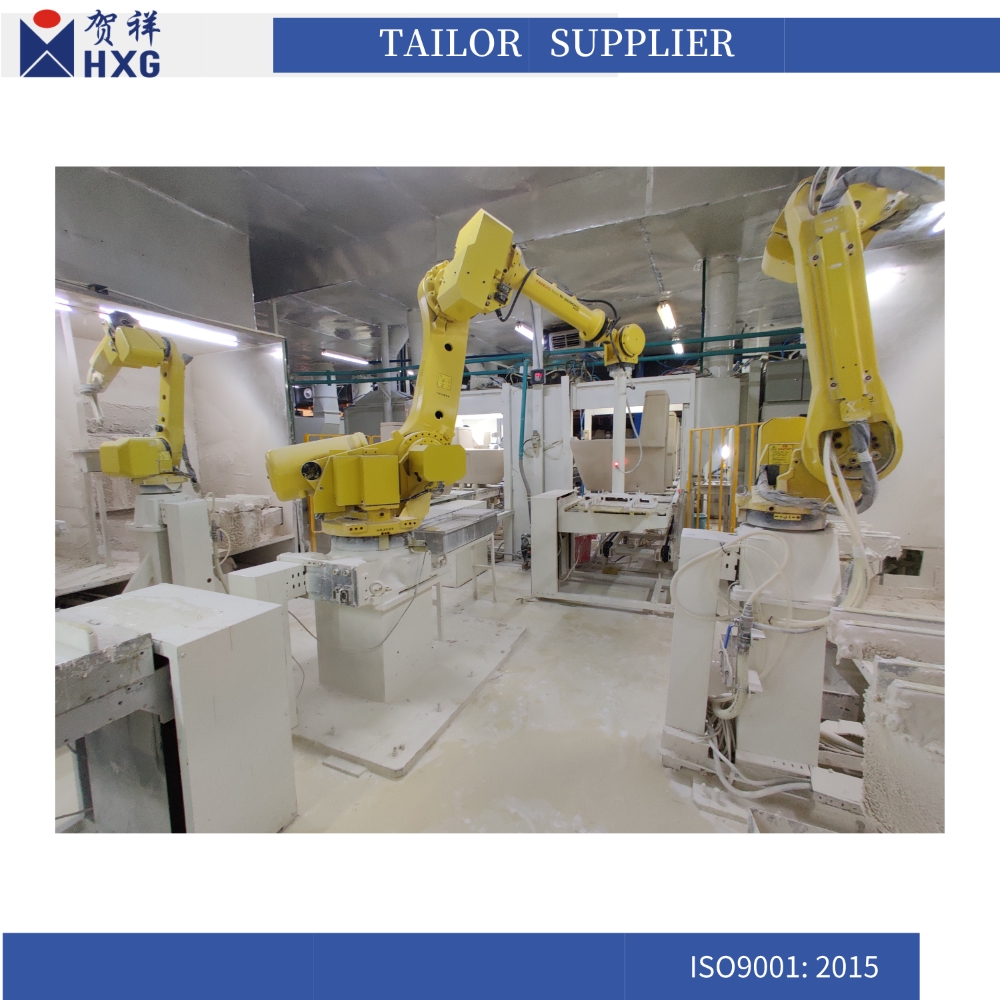
As the global manufacturing landscape shifts toward mass customization and stricter quality standards, multi-axis automation has emerged as the industry standard for advanced ceramic production. Its strengths lie in its ability to combine mechanical repeatability with software-driven adaptability. This directly addresses the most pressing pain points in modern glazing departments.
Unmatched Precision for Complex Shapes
The most significant advantage of a Robotic Glazing Line is its unmatched precision when dealing with complex geometries. Sanitaryware products feature internal channels, hidden rims, and deep cavities. A standard fixed-gun system cannot effectively coat these blind spots without causing severe overspray on the exterior surfaces.
Instead of pools of glaze accumulating at the bottom of a basin, a 6-axis robotic arm physically maneuvers the spray nozzle right into tight spaces. It angles the gun perfectly perpendicular to the target surface. The robot maintains an optimal standoff distance and gun angle throughout the entire tool path. This eliminates the running and dry spots that frequently plague manual operations. With a repeatability of ±0.1mm, this precision directly translates to a drastic reduction in post-firing defects and costly rework.
Flexibility for High-Mix, Low-Volume Production
Modern consumer demand is highly fragmented. Manufacturers must produce a wider variety of Stock Keeping Units in much smaller batches. This high-mix, low-volume manufacturing paradigm is exactly where a robotic cell outshines traditional continuous lines.
Switching from producing a batch of pedestal sinks to a batch of wall-hung toilets requires no physical reconfiguration of the spray booth. The floor operator simply selects the corresponding program from the Human-Machine Interface touch screen. The robot instantly updates its motion path, spray parameters, and cycle times. This digital changeover process takes mere seconds. It completely eliminates the hours of mechanical downtime typically required to unbolt and adjust fixed spray guns.
Material Savings and Consistent Quality
Ceramic glaze is a highly expensive raw material. Minimizing waste is a primary objective for any production manager looking to protect profit margins. Manual glazing and older mechanical lines often suffer from terrible transfer efficiency. A massive percentage of the atomized glaze misses the product entirely and ends up in the water wash filtration system.
By precisely triggering the spray gun only when it is perfectly aligned with the target surface, a robot optimizes material usage. The programmable logic controller coordinates the fluid delivery with the robot motion. The spray shuts off instantly between gaps or during repositioning moves. Furthermore, removing human fatigue from the equation guarantees that the first piece of the shift receives the exact same coating thickness as the thousandth piece.
To make an objective, data-driven purchasing decision, we must acknowledge the scenarios where alternative equipment remains the superior choice. A rotary system is not obsolete. Rather, it is a highly specialized tool that delivers exceptional efficiency under very specific manufacturing conditions.
High-Volume, Low-Mix Production
Imagine your facility is contracted to churn out 10,000 identical dinner plates or standard flat tiles every single day. In this scenario, the continuous loop of a Carrousel Glazing Line is remarkably efficient. The continuous nature of the rotary conveyor means there is virtually no idle time between pieces. Products are loaded, sprayed, and unloaded in a seamless, uninterrupted flow. The raw output speed of a carousel can easily exceed that of a single robotic arm here, making it a highly effective solution for economies of scale where product variation is almost zero.
Simpler Ceramic Products
Products with flat surfaces, shallow profiles, or simple, uniform curves simply do not require multi-axis articulation. Plates, saucers, simple bowls, and flat architectural ceramics can be coated perfectly using fixed or mechanically oscillating spray guns. When the geometry of the product allows for a direct, line-of-sight application of glaze, the mechanical simplicity of a rotary line provides a reliable and cost-effective solution.
Choosing between these two systems requires a systematic evaluation of your specific production parameters. Plant managers must analyze their current product portfolio, facility constraints, and long-term strategic goals. Stop looking at abstract concepts and start looking at hard operational metrics. The following framework provides a practical, side-by-side comparison to facilitate your purchasing decision.
Evaluation Metric | Robot Glazing Machine | Carrousel Glazing Line |
|---|---|---|
Product Geometry | Complex, multi-dimensional, deep hidden cavities | Simple, flat, uniform curves, line-of-sight |
Daily SKU Changes | High frequency. Ideal for 5+ changes per shift. | Low frequency. Ideal for running 1 product for weeks. |
Changeover Protocol | Instantaneous via digital HMI program selection. | Slow, requiring mechanical adjustment of spray guns with wrenches. |
Glaze Transfer Efficiency | Very High. Targeted spray paths drastically reduce waste. | Moderate to Low. Fixed continuous spray leads to heavy overspray. |
Floor Space Requirements | Compact. Highly flexible integration into existing linear lines. | Massive. Requires a large, dedicated circular footprint. |
Product Type: Sanitaryware vs. Tableware
The most decisive factor is the physical geometry of your products. As a general rule of thumb within the ceramic industry: if your facility manufactures sanitaryware, a robot is almost always the financially and technically superior choice. The intricate internal channels of toilets and bidets demand multi-axis articulation. Conversely, if your primary output consists of flat tableware or simple cylindrical items, a carousel may provide sufficient quality at a lower initial integration complexity.
Floor Space and Facility Layout
Industrial floor space is a premium asset. When planning a factory upgrade, the physical footprint of the equipment is a critical constraint. Robots are highly compact. They can often be tucked into enclosed, modular spray booths. They integrate easily into existing linear conveyors or set up as standalone work cells. This offers high spatial efficiency. In contrast, a rotary line requires a massive, dedicated circular footprint to accommodate the table, multiple spray stations, and loading zones.
Future-Proofing Your Production
Manufacturing is never static. Consumer preferences are rapidly shifting toward custom, varied, and complex designs. Investing in capital equipment requires looking five to ten years into the future. A robotic system inherently future-proofs your production line. If your marketing department introduces a radical new product shape next year, a robot adapts via a simple software update. Fixed machinery may require costly mechanical retrofitting or prove entirely incapable of handling the new geometry.
Capital equipment procurement is ultimately a financial decision. While the engineering benefits of automation are clear, executives require a rigorous cost-benefit analysis. Transitioning to advanced automation involves shifting expenses from operational labor and material waste into upfront capital investment.
Initial Investment vs. Long-Term Savings
It is an objective fact that the initial procurement and integration costs of a 6-axis robotic system are generally higher than those of a standard mechanical carousel. However, evaluating the system solely on capital expenditure is a flawed financial model. The true metric of success is the payback period.
Robotic systems generate aggressive long-term savings in three primary areas. First, by increasing transfer efficiency, factories often see a 15 to 30 percent reduction in glaze consumption. Given the high cost of raw materials, this saving alone offsets the machine cost rapidly. Second, precise, repeatable coating eliminates human error. This significantly lowers the scrap and rework rates after the firing process. Third, modern servo-driven robots consume far less power than the massive mechanical drives required to rotate heavy carousel tables.
Solving the Labor Shortage
The manufacturing sector faces a severe shortage of skilled labor. Manual glazing is a highly specialized trade that takes years to master. It is also physically demanding and exposes workers to hazardous airborne silica and glaze particles.
Implementing a robotic cell directly solves this labor crisis. It replaces the need to recruit, train, and retain highly skilled manual sprayers. Existing staff can be upskilled to operate the robot interface. This moves them out of the hazardous spray environment and into safer, supervisory roles. It reduces direct labor costs while significantly lowering liability, insurance premiums, and ergonomic-related workplace injuries.
For plant managers accustomed to traditional fixed machinery, upgrading to robotics can seem like a daunting operational leap. However, modern robotic systems are designed specifically for rough industrial integration. They minimize downtime and simplify the entire transition process.
Integration with Existing Conveyors
A common misconception is that installing a robot requires tearing out the entire existing factory infrastructure. In reality, modern six-axis robots are highly adaptable. They can be easily retrofitted to work alongside your current production lines. Using advanced line-tracking software and encoder feedback, the robot synchronizes its movements with your existing linear conveyors. It sprays products continuously as they move down the line. This modular approach allows factories to upgrade their capabilities in phases, avoiding catastrophic production halts.
Programming and Operator Training
Another barrier to entry is the fear that operating a robot requires a team of advanced software engineers. This is simply no longer true. Contemporary systems utilize intuitive teach-pendant programming. A floor supervisor can manually guide the robotic arm through the desired spray path, and the system records the precise coordinates.
In addition, offline 3D simulation software allows production engineers to import CAD models of new products. You can simulate the entire glazing process and generate the code on a laptop before the physical product ever reaches the floor. Your current staff can be trained to manage, troubleshoot, and program the line in a matter of days, not months.
Selecting the right technology is only half the battle. Choosing the right engineering partner ensures that the equipment actually delivers on its theoretical promises. HXG Machine specializes in the design, manufacturing, and integration of state-of-the-art automatic glazing equipment tailored specifically for the ceramic and sanitaryware industries.
Rather than pushing one-size-fits-all machinery, HXG Machine conducts thorough production audits to engineer customized solutions. By analyzing your specific product geometries, fluid dynamics, and facility layouts, they provide systems that guarantee precise coating thickness. These systems drastically reduce material waste and improve overall factory efficiency. Their commitment to robust mechanical design and user-friendly software integration ensures that your transition to automated glazing is seamless, reliable, and immediately profitable.
The modern manufacturing landscape demands high flexibility, strict quality control, and aggressive cost management. A continuous carousel line still holds value for simple, high-volume mass production. Yet, it heavily struggles to meet the nuanced demands of today's dynamic, high-mix market.
Ultimately, a robot glazing machine makes far more sense when your product mix is diverse, your shapes are complex, and your goal is to maximize material savings while ensuring flawless quality. By eliminating manual touch-ups, reducing defect rates, and future-proofing your facility against shifting consumer trends, robotic integration is the definitive path forward for ambitious manufacturers.
Ready to modernize your production floor? Evaluate your current bottlenecks and explore the precise specifications of advanced automatic glazing equipment. Visit https://www.hxgmachine.com to find the exact robotic solution that matches your facility's unique production demands and start transforming your bottom line today.
While carousels may have a higher raw output for simple, flat items, robots offer a higher effective speed for complex items. They eliminate the time-consuming need for manual touch-ups post-spraying and significantly reduce defect rates, resulting in a higher yield of sellable, first-quality products per hour.
It is incredibly straightforward. Modern systems use point-to-point physical teaching via a pendant or offline 3D software based on CAD models. This means a completely new product geometry can be programmed, tested, and saved to the system in a matter of hours by standard operational staff, without needing a computer science degree.
Robots require routine, basic maintenance such as the daily cleaning of the spray guns, checking of fluid hoses for blockages, and standard periodic lubrication of the robotic joints. Because they are meticulously sealed against wet and dusty environments with high IP ratings, they are generally highly reliable and boast excellent uptime.
Yes. By mathematically optimizing the spray path and controlling the fluid flow rate dynamically, robotic systems can reduce glaze consumption by 15 to 30 percent when compared to manual spraying or less precise mechanical automatic methods. This reduction in overspray translates directly into significant financial savings.
For most ceramic and sanitaryware plants, the Return on Investment typically ranges between 12 and 24 months. This rapid payback is driven by a combination of reduced glaze waste, lower manual labor costs, and a significant drop in post-firing scrap rates due to consistent coating application.
Absolutely. Modern robotic glazing cells can be engineered with automatic color-changing systems and multiple fluid delivery circuits. The robot can flush its lines and switch to a new glaze color in a matter of seconds, making it highly efficient for high-mix production runs requiring various finishes.


