
Views: 0 Author: Site Editor Publish Time: 2026-09-07 Origin: Site


Global demand for sanitary ware is surging. Step onto a modern factory floor, and the endless rows of dripping plaster molds are gone. Workers no longer strain under heavy, water-logged loads. Traditional casting simply fails to meet today's production speeds. It leaves manufacturers battling soaring labor costs, sluggish cycles, and outdated methods that frequently destroy product quality.
To stay competitive, plant managers must rethink their entire floor plan. In this technical breakdown, we will explore exactly which automated systems can efficiently scale your plant's production. You will discover how to drastically reduce overhead, eliminate consumable waste, and future-proof your manufacturing lines.
Upgrading to automated casting lines slashes production cycle times from several hours to a mere 15 to 30 minutes.
Modern machinery offers highly specialized configurations. This includes dedicated multi-cavity lines for wash basins, complex core-pulling systems for toilets, and high-tonnage presses for heavy shower trays.
Implementing advanced equipment drastically lowers manual labor requirements. It minimizes ergonomic hazards and standardizes wall thickness across high-volume runs.
Transitioning from plaster to microporous resin molds extends mold lifespans from fewer than 100 cycles to tens of thousands of cycles.
Selecting the right machinery requires a rigorous evaluation of your facility's daily output targets, desired automation levels, and long-term return on investment.
To truly grasp the value of modern manufacturing technology, we must look at the bottlenecks of legacy systems. For decades, the industry relied heavily on traditional slip casting using plaster of Paris molds. In this older process, liquid clay is poured into a dry plaster mold. The plaster passively absorbs the water through capillary action. Slowly, a solid ceramic layer forms against the mold walls.
While functional, this method chokes modern production rates. The primary enemy is time. A standard plaster mold casting cycle takes anywhere from 12 to 24 hours just to achieve the necessary green body thickness. Consequently, hitting high daily output targets requires thousands of plaster molds. This demands massive, sprawling factory floor space.
Traditional casting drains labor resources. Operators wrestle with heavy molds and delicately extract fragile green bodies. This manual handling inevitably spikes ergonomic injuries and ruins yield rates through human error. To make matters worse, plaster molds degrade rapidly. They typically require complete replacement after just 80 to 120 casting cycles.
The modern era of manufacturing completely rewrites this process. By integrating advanced production lines, plants shift focus from manual labor to automated, high-efficiency technology. Modern systems utilize brute mechanical pressure rather than passive capillary action. This fundamental change in physics condenses the factory footprint. It transforms the plant into a controlled, data-driven environment where yield rates are predictable and remarkably stable.
Transitioning a plant to modern standards requires a comprehensive ecosystem of equipment. Before examining specific casting units, engineering teams must understand the foundational machinery needed to support a high-pressure automated line.
The success of high-pressure casting relies entirely on the precise rheology of the ceramic slip. Traditional casting can tolerate minor variations in slip density. Automated machinery, however, demands a perfectly homogenized mixture. The core equipment here includes high-speed blungers. These machines aggressively mix the raw clay, feldspar, quartz, and water to break down stubborn agglomerates.
Following the blunging process, the slip transfers to large storage agitators. These continuous mixing tanks prevent heavier particles from settling, ensuring a uniform specific gravity. Before the slip reaches the casting machines, it must pass through industrial vibrating screens and high-intensity magnetic separators. The screens filter out oversized impurities. Simultaneously, magnetic separators pull out trace iron contaminants that cause disastrous discoloration during kiln firing.
A defining characteristic of the modern approach is abandoning plaster molds in favor of microporous resin molds. These highly engineered molds feature a network of microscopic pores. During the pressurized casting process, these micron-sized channels allow water to be forcefully expelled.
Resin molds are significantly heavier and far more robust than plaster. Manual handling is virtually impossible. Therefore, plants must invest in heavy-duty mold clamping machinery. This includes hydraulic presses and automated clamping frames designed to hold multi-part resin molds securely. The machinery exerts immense clamping force to counteract the internal pressure of the slip injection. This ensures the molds do not separate or leak during the intense casting cycle.
The blistering speed of modern casting machines is useless if post-casting processes create a bottleneck. To prevent this, modern facilities integrate rapid drying and glazing automation. Once extracted, the green body moves via conveyors to climate-controlled chamber dryers. These machines precisely manipulate humidity and temperature gradients. They remove residual moisture rapidly without causing shrinkage cracks. Afterward, robotic glazing machines apply a uniform coat of enamel using programmed spray paths to minimize expensive glaze waste.
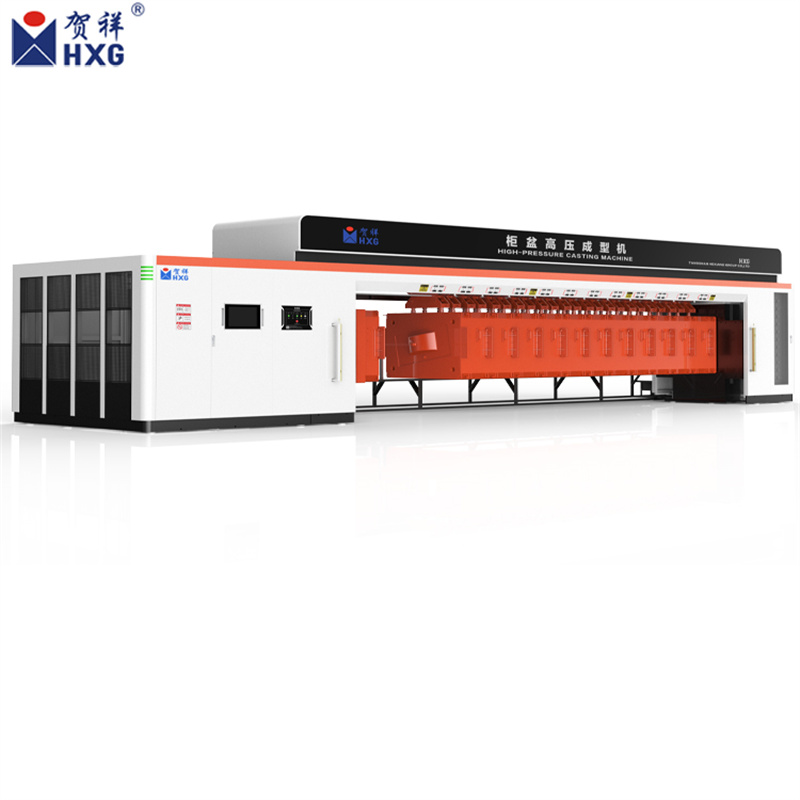
At the beating heart of the modern sanitary ware plant is the High Pressure Casting Machine. While this technology represents a significant capital expenditure, it is the absolute primary driver of operational efficiency and long-term profitability.
An automated system of this caliber injects ceramic slip into microporous resin molds under significant mechanical pressure. Depending on the product thickness and slip composition, this pressure typically ranges from 10 to 15 bar. By utilizing mechanical force rather than passive absorption, the machine accelerates clay particle consolidation. It forms a rock-solid green body in a fraction of the time required by legacy methods.
Operating this machinery follows a tightly choreographed automated sequence. First, robust hydraulic cylinders lock the resin molds into place. Industrial models often apply clamping forces ranging from 40 to over 100 tons to create an airtight seal. Once secured, the slip delivery system injects liquid clay at a low pressure to completely fill the cavity without trapping air bubbles.
Next, the system initiates the high-pressure phase. Heavy-duty pumps force additional slip into the mold at up to 15 bar. This immense pressure physically squeezes water out through the microscopic pores of the resin mold. A dense, uniform layer of clay rapidly builds against the mold walls. Once the desired wall thickness is achieved, excess liquid slip drains back into the storage system.
Finally, compressed air is injected through the resin mold pores. This critical air purge serves a dual purpose. It clears the pores of residual water to prepare for the next cycle, and it creates a micro-layer of air between the mold and the ceramic body. This allows for seamless, automated demolding.
Sanitary ware encompasses a dizzying variety of shapes and structural complexities. Consequently, modern production lines are not a one-size-fits-all solution. Equipment manufacturers design specialized casting configurations tailored to unique geometric requirements.
Toilets are arguably the most complex sanitary ware products to cast. A standard one-piece or two-piece toilet features intricate internal geometries, including the bowl, the rim, and the hidden siphon trapway. Casting these hidden features requires highly specialized, multi-part resin molds consisting of four to seven distinct interlocking pieces.
Machinery designed for toilets must feature complex hydraulic core-pulling mechanisms. These mechanisms automatically insert and extract the mold sections that form the internal hollows. Furthermore, the pressure application must be meticulously calibrated. The slip must reach deep, narrow cavities without causing structural weak points.
In contrast to the complex internal cavities of a toilet, wash basins generally feature flat or moderately curved surfaces. They have much simpler demolding requirements. To maximize production efficiency for these specific products, forward-thinking manufacturers utilize dedicated Wash Basin HPCM systems.
These machines are specifically optimized for multi-cavity production. Because the geometry is less complex, a single hydraulic clamping frame can hold a massive resin mold containing multiple basin cavities. Depending on the machine tonnage, setups often feature two, four, or even up to eight cavities. This allows the machine to cast several basins simultaneously during a single 20-minute cycle. The machinery is typically oriented vertically to facilitate rapid slip drainage and easy extraction by a robotic arm, making it an incredibly high-yield asset.
Modern production lines easily accommodate heavier or uniquely shaped items. Shower trays have a massive surface area but relatively low height. The machinery required for shower trays must possess exceptionally high clamping tonnage to counteract the pressure exerted over such a large surface area. Bidets and urinals require machinery that bridges the gap between basin and toilet complexity, often utilizing specialized tilt-casting mechanisms to ensure proper slip flow around unique curves.
The sanitary ware sector is currently undergoing a rapid technological evolution. Global manufacturing standards are shifting toward higher efficiency and lower environmental impact. Decision-makers investing in equipment today must ensure their chosen systems are forward-compatible with these emerging industry trends.
The era of isolated, purely mechanical machinery is ending. Modern manufacturing facilities aggressively embrace smart factory integration. Future-proof equipment is routinely equipped with advanced sensor arrays and Supervisory Control and Data Acquisition systems. These sensors continuously monitor critical production variables in real-time. By tracking slip viscosity, hydraulic clamping force, and injection pressure, plant engineers can optimize the casting cycle down to the millisecond.
Environmental compliance is no longer a secondary concern. Traditional ceramic casting is notoriously resource-heavy, generating significant water waste. Modern systems are engineered to align with green manufacturing protocols. High-pressure systems extract massive amounts of water from the ceramic slip. Advanced machinery captures this expelled water, filters it, and recirculates it back into the slip preparation process. This closed-loop recycling drastically reduces the factory water footprint.
Purchasing industrial manufacturing equipment is a major capital decision. Plant managers and technical directors must evaluate several critical variables to ensure the chosen machinery aligns perfectly with operational goals.
The initial step is mathematically defining your production targets. Calculate your required daily output to determine the size, tonnage, and number of casting machines needed.
For instance, if a plant needs to produce 600 wash basins per day across two 8-hour shifts, the hourly requirement is 37.5 basins. If a specific machine operates on a 20-minute cycle, it completes 3 cycles per hour. Therefore, it must produce at least 13 basins per cycle to meet the target. This calculation directly dictates whether the plant should invest in multiple single-cavity machines or a large-scale, 8-cavity system.
Equipment is available across a broad spectrum of automation. Semi-automatic systems manage the high-pressure injection and mold clamping but rely on human operators to manually extract the green body using pneumatic hoists. Fully automatic systems integrate robotic arms and Automated Guided Vehicles to extract the product, trim the edges, and transport it to the drying chamber without human intervention. Fully automated lines require higher initial capital but offer the lowest long-term operational costs.
Transitioning from traditional slip casting to modern Sanitary Ceramic Equipment represents a major operational shift. While the upfront capital expenditure is undeniably higher than traditional setups, a comprehensive analysis of the long-term Return on Investment reveals that modernizing your plant is a strategic necessity.
The ROI is typically realized through four primary channels. First, automated machinery fundamentally changes labor dynamics. A single operator can oversee multiple casting modules simultaneously from a control panel. Automated demolding eliminates physical strain on workers, reducing workplace injuries and lowering overall labor costs.
Second, energy savings are substantial. High-pressure systems squeeze significantly more water out of the slip during the casting phase. The green bodies emerge with a much lower moisture content, requiring far less thermal energy and time in the drying phase. This reduction in natural gas or electricity consumption directly improves the bottom line.
Third, precise digital control ensures uniform density and consistent wall thickness across every single piece. By reducing the scrap rate from typical traditional averages to near-perfect yields, manufacturers save on wasted raw materials and lost production time. Finally, the microporous resin molds used in high-pressure systems are engineered for extreme durability. With proper automated backwashing, a single resin mold can reliably perform for 30,000 to 50,000 cycles, eliminating the massive costs of running a continuous plaster mold-making shop.
Operational Metric | Traditional Plaster Casting | Modern High-Pressure Casting |
|---|---|---|
Casting Cycle Time | 12 to 24 hours | 15 to 30 minutes |
Mold Material | Plaster of Paris | Microporous Resin |
Mold Lifespan | 80 to 120 cycles | 30,000 to 50,000 cycles |
Moisture Content (Post-Cast) | 18% to 22% | 12% to 15% |
Floor Space Efficiency | Very Low (Massive horizontal spread) | Very High (Compact, vertical modularity) |
Labor Requirement | High (Manual pouring and handling) | Low (Automated PLC operation) |
Average Defect Rate | Moderate to High (Human error prone) | Extremely Low (Precision controlled) |
By aggregating the savings from labor efficiency, energy reduction, minimized defect rates, and extended mold life, most industrial facilities report a full return on their machinery investment within 1.5 to 3 years.
Upgrading your casting process is a smart, unavoidable choice in today's demanding industrial landscape. Modern equipment helps factories stay fiercely competitive in a market that demands both speed and precision. Investing in better technology aggressively lowers your long-term operational costs by reducing labor, slashing energy consumption, and eliminating consumable waste.
Beyond the financial savings, it fundamentally improves the overall structural and aesthetic quality of your products. Evaluate your current production lines as soon as possible to identify bottlenecks. To explore custom machinery configurations tailored to your specific product geometries and capacity needs, visit HXG Machine and take the first step toward transforming your factory floor.
The fundamental difference lies in the physical mechanism used to extract water from the ceramic slip. Traditional casting relies entirely on the natural capillary action of dry plaster molds. The plaster slowly absorbs water, a passive process taking 12 to 24 hours. In contrast, high-pressure systems utilize mechanical force. The machinery injects the slip into a microporous resin mold under high hydrostatic pressure, usually between 10 and 15 bar. This intense pressure forces the water out through microscopic pores at an accelerated rate, reducing the cycle to mere minutes and resulting in a denser ceramic body.
When properly maintained, microporous resin molds boast an exceptionally long operational lifespan. They typically endure between 30,000 and 50,000 casting cycles. This is a monumental improvement over traditional plaster molds, which degrade after just 80 to 120 cycles. The longevity is achieved through durable chemical composition and automated maintenance routines. After every cycle, the equipment forces high-pressure water and compressed air back through the mold structure. This backwashing clears residual clay particles, preventing clogging and ensuring water-extraction efficiency over years of use.
Facilities transitioning from traditional plaster casting to high-pressure automated systems typically reduce their required casting floor space by 60% to 70%. Traditional methods require thousands of molds laid out horizontally across massive drying racks to meet daily quotas. Modern machinery operates vertically and completes cycles in under 30 minutes. A single compact machine can replace the output of hundreds of plaster molds, freeing up valuable square footage for other operations or allowing for massive capacity expansion within the same building footprint.
For optimal performance in high-pressure systems, the ceramic slip should generally be maintained at a temperature between 35°C and 40°C. Maintaining this temperature range lowers the viscosity of the slip, allowing it to flow more easily into complex mold cavities. Furthermore, warmer slip releases its water content more readily when subjected to mechanical pressure, which directly contributes to faster casting cycles and a more uniform green body density. Advanced slip preparation systems utilize heat exchangers to maintain this precise temperature year-round.
Yes, these specific casting machines are inherently modular. While optimized for the flat or moderately curved geometries typical of wash basins, the core technology remains highly adaptable. By exchanging the resin molds and adjusting the programmable logic controller parameters, manufacturers can utilize the same machinery to produce squatting pans, toilet lids, water tanks, or small shower trays. This modularity allows plant managers to quickly pivot production lines in response to changing market demands without investing in entirely new casting infrastructure.


