
Views: 0 Author: Site Editor Publish Time: 2026-09-10 Origin: Site


Global demand for modern bathroom fixtures is surging. Rapid urbanization is pushing ceramic factories to their absolute limits. Today's consumers expect smart, rimless, and aesthetically perfect toilets. Consequently, ceramic manufacturers face immense pressure to scale up production without sacrificing yield.
Looking at the broader manufacturing landscape, the shift toward Industry 4.0 in sanitary ware is undeniable. Recent market analyses indicate a massive transition from labor-intensive setups to fully automated production cells. Why? Because the modern water closet—especially smart toilets with integrated electronic bidets—requires internal geometries so precise that manual casting simply cannot achieve the necessary dimensional stability. Factories are realizing that to survive the margin squeeze caused by rising energy and labor costs, adopting high-pressure technology is no longer optional; it is the baseline for survival.
Relying on traditional manual casting is a dead end. These legacy processes are slow. They depend heavily on physical labor. They invite human error at every step. Upgrading to advanced industrial equipment is the only logical way out.
Let's look at the mechanics of high-pressure equipment from a frontline engineering perspective. We will explore how the right machinery transforms a sluggish factory floor into a high-yield, automated manufacturing hub.
Mechanical Pressure is Mandatory: High-pressure casting slashes cycle times from a sluggish 24 hours to a rapid 15-25 minutes.
Resin Over Plaster: Porous resin molds deliver up to 40,000 casting cycles, leaving traditional plaster tooling in the dust.
Automation Drives ROI: Automated demolding cuts direct labor costs and stops the micro-fractures caused by manual handling.
Ecosystem Integration: Standalone machines fail without synchronized slip preparation, robotic glazing, and optimized firing curves.
Scaling up requires a ruthless evaluation of cycle time, footprint, and defect rates. You cannot just throw more manual labor at the problem.
Manufacturing water closets is an engineering headache compared to simpler goods like basins or flat tiles. The internal geometry is exceptionally complex. Think about S-traps, P-traps, flushing rims, and concealed water channels. Even a millimeter of warping in the internal water channel ruins the flush dynamics. Achieving consistent liquid clay (slip) rheology and uniform moisture extraction across thousands of units is practically impossible with ambient drying and human operators.
Traditional battery casting relies heavily on plaster molds. Plaster absorbs water passively through capillary action. It is cheap upfront but terrible for scaling. Picture a typical legacy factory floor. Workers wrestle with 50kg water-logged plaster molds in a humid, slippery environment. Plaster saturates quickly. After just one or two casts, those molds must sit in climate-controlled rooms for hours to dry out.
Furthermore, manual demolding is grueling. Operators pry molds apart by hand, inevitably causing invisible micro-cracks in the greenware. The massive footprint required just to house thousands of drying plaster molds destroys your space utilization metrics.
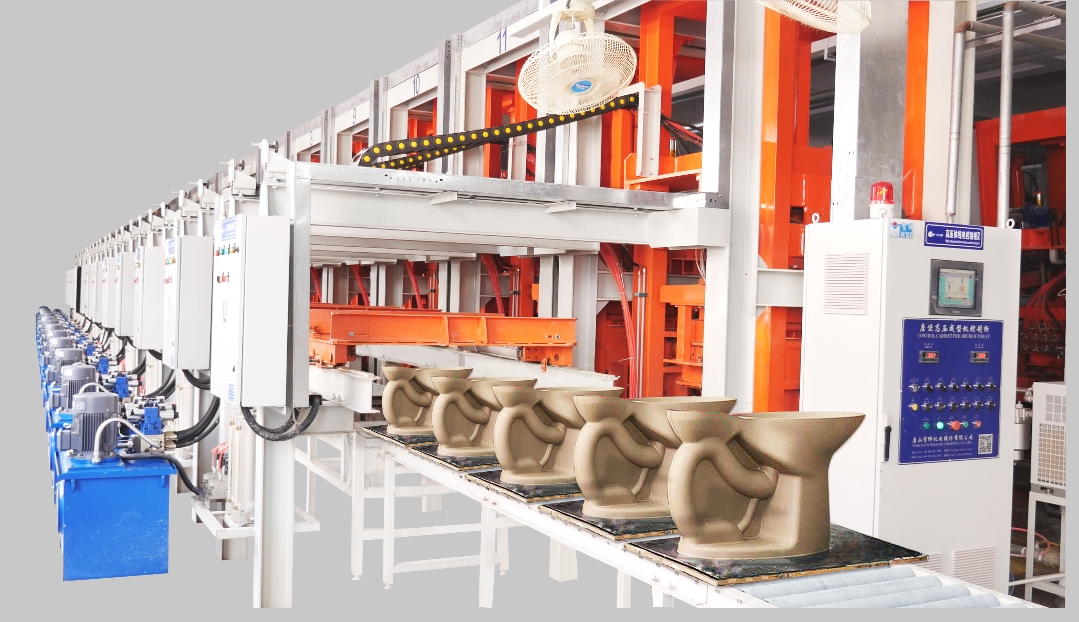
To break this bottleneck, forward-thinking factories shift from passive absorption to active, mechanical dewatering.
What exactly is a Toilet HPCM? It is a highly specialized piece of forming machinery. Instead of waiting for plaster to suck out moisture, this equipment injects slip into a tightly clamped mold cavity. We are talking about intense mechanical pressure—typically ranging between 10 to 15 bar.
This massive pressure forces the water content out of the slip and through the microscopic pores of the mold incredibly fast. Once the precise wall thickness is hit, excess slip drains automatically. Next, compressed air (around 2-3 bar) is introduced to consolidate the clay body further and cleanly release it from the mold surface. A process that historically took an entire day is condensed into a 15-minute precision task.
The secret weapon here is the porous resin mold. Plaster degrades rapidly. Resin endures. Engineered to withstand extreme clamping forces, a premium porous resin mold easily survives 30,000 to 40,000 cycles. You eliminate daily tooling replacement costs, stop mold changeover downtime, and get a flawless surface finish that barely needs manual fettling.
Parameter | Traditional Slip Casting | High-Pressure Casting (HPCM) |
|---|---|---|
Cycle Time | 12 - 24 Hours | 15 - 25 Minutes |
Mold Material | Standard Plaster | Micro-porous Resin |
Mold Lifespan | 80 - 100 Cycles | 30,000 - 40,000 Cycles |
Yield Rate (Grade-A) | Highly Variable (~75%) | Consistently High (>95%) |
Floor Space Efficiency | Poor (Requires massive drying rooms) | Excellent (Vertical, compact operation) |
When evaluating CapEx for major equipment, look past the shiny exterior. You must scrutinize the actual engineering specs to ensure long-term viability.
Fast Cycle Times and Output Capacity: The defining ROI metric is cycle time. Modern high-pressure systems operate on an entirely different scale. A multi-cavity Water Closet Casting Machine can output dozens of greenware pieces per shift. Depending on whether you run a 2-cavity or 4-cavity setup, a single automated unit allows you to tackle massive export contracts without expanding your labor force.
Intelligent Automation and PLC Controls: Consistency demands precise data management. High-end machinery utilizes advanced Programmable Logic Controllers (PLCs) to govern every micro-variable. The PLC continuously monitors slip temperature, injection pressure curves, and holding times. If the slip viscosity fluctuates slightly, the system auto-adjusts the holding pressure. The final wall thickness remains exact. Human guesswork is completely removed from the equation.
Defect Reduction and Yield Rates: Manual casting traps air bubbles. These hidden pinholes turn into structural cracks inside the kiln. High-pressure casting crushes this issue. The sustained 15-bar mechanical force compresses the clay particles tightly together, forging a highly dense greenware body. Automated demolding mechanisms then extract the toilet using suction pads and precise robotic arms. No more prying. No more handling fractures.
A high-speed casting machine cannot run in a vacuum. If your downstream processes lag, you simply create a faster bottleneck.
Slip Preparation and Automated Glazing: High-volume casting demands flawless rheology. Liquid clay must be prepped using high-shear blungers and powerful electromagnets to remove impurities. Once the green body is formed, manual glazing is too slow and wastes material. Integrating multi-axis robotic glazing arms ensures the high volume of greenware is coated rapidly, saving up to 20% on glaze materials.
Automated Handling and AGVs: Handling unfired ceramic is risky. To protect your casting investment, integrate the standalone units into a fully automated Sanitary Ware Production Line. By utilizing Automated Guided Vehicles (AGVs) and robotic transfer grips, factories gently transport greenware from the casting machine to the drying chambers. Removing human hands slashes scrap rates instantly.
Optimized Firing Technology: Because high-pressure casting mechanically squeezes out the water, the greenware emerges with a significantly lower moisture content. You bypass the massive, energy-hogging mold-drying phase entirely. In the continuous tunnel kiln, firing curves can be optimized aggressively, drastically reducing natural gas consumption per unit.
Selecting a vendor is a strategic, decades-long decision. Look closely at their engineering backbone and field support capabilities.
Evaluating Technical Support and SLAs: High-tech machinery relies on complex hydraulics and precise pneumatics. When a valve sticks, production stops. Assess spare parts availability and guaranteed response times. A top-tier vendor provides remote PLC diagnostics to troubleshoot software issues instantly. Comprehensive Service Level Agreements (SLAs) are non-negotiable.
Customization for Specific Toilet Designs: European markets demand compact, wall-hung, rimless toilets. North American consumers want massive, floor-standing siphonic models. Your machinery manufacturer must possess the in-house CNC capability to design and mill custom porous resin molds for these distinct geometries. The machine's clamping system must also be modular to accommodate varying mold sizes seamlessly.
Transitioning to automated systems requires capital, but the math works out quickly when analyzing long-term profitability.
The initial CapEx is rapidly offset by the extended 40,000-cycle lifespan of resin molds. You slash your annual tooling budgets immediately. Furthermore, because the machine eliminates air bubbles and handling fractures, your Grade-A yield jumps from a volatile 75% to a stable 95%. This drastic reduction in post-firing scrap accelerates the payback period. Combined with lower energy bills from reduced drying room dependency, your cost per unit drops to highly competitive levels.
Scaling toilet manufacturing to meet modern global demand is impossible with archaic manual methods. Upgrading to high-pressure casting is a critical survival tactic in today's fiercely competitive market. By embracing intelligent automation, resin mold technology, and full-line integration, you lower operational costs, eliminate defects, and future-proof your factory. For facilities ready to make the leap, evaluating the exact technical parameters of your chosen equipment is step one. Explore industry-leading, highly customizable solutions at Hexiang Machinery to find the exact configuration that matches your production targets.
Traditional casting relies on the passive capillary action of plaster molds to absorb water from the clay, a sluggish process taking up to 24 hours per cycle. An HPCM utilizes active mechanical pressure (10-15 bar) and porous resin molds to force water out rapidly, completing a full casting cycle in just 15 to 25 minutes.
By operating vertically and eliminating the need for massive climate-controlled plaster drying rooms, a high-pressure casting system can reduce the required factory footprint by up to 70% compared to a sprawling traditional manual casting layout.
For complex internal geometries like rimless toilets or siphonic traps, the ideal slip injection pressure typically ranges between 10 to 15 bar. This immense force ensures uniform wall thickness and completely eradicates trapped air bubbles within the clay body.
High-quality porous resin molds are engineered for extreme mechanical stress. They reliably last for 30,000 to 40,000 casting cycles, offering a monumental improvement over traditional plaster molds which degrade and warp after just 80 to 100 cycles.
While integration requires specific infrastructure upgrades—such as high-pressure compressed air lines, precise slip rheology controls, and water recycling systems—top-tier machinery manufacturers provide comprehensive end-to-end engineering services to ensure a seamless transition within your existing factory layout.


