
Views: 0 Author: Site Editor Publish Time: 2026-09-11 Origin: Site


Are high glaze costs draining your operational budget? Step onto any traditional ceramic factory floor, and the inefficiencies become immediately apparent. Manual spraying inherently slows down output and creates excessive, costly waste. Modernizing your production line is no longer just an option but a strict requirement for survival in a highly competitive global market. Implementing the proper industrial equipment drastically cuts material loss while accelerating your entire workflow.
In this comprehensive engineering guide, you will discover exactly how advanced sanitary ware machinery improves operational efficiency, recovers wasted raw materials, and ultimately boosts your bottom line.
Automated Precision: Upgraded equipment utilizes robotic kinematics and automated fluid control to ensure consistent coating. This systematically reduces baseline defect rates before the product ever reaches the kiln.
Continuous Production: A synchronized workflow eliminates traditional batch bottlenecks. The result is a seamless transition from loading to unloading.
Cost Mitigation: Implementing dedicated recovery infrastructure captures and filters overspray. Facilities routinely see measurable reductions in annual raw material expenditures.
Eco-Friendly Operations: Advanced machinery lowers environmental impact by minimizing wastewater discharge and heavy solid waste, directly aligning facilities with stringent industrial sustainability standards.
Recent market intelligence highlights a decisive pivot in the global ceramic sector. Driven by volatile raw material costs, particularly the rising prices of zirconium silicate and specialized frits, facility managers are rapidly moving away from sheer capacity expansion. Instead, the focus has shifted entirely toward smart, closed-loop systems that emphasize resource recovery and strict energy efficiency.
Furthermore, stringent environmental, social, and governance regulations are forcing plants to minimize their ecological footprint. Upgrading outdated application booths to automated systems is now viewed as a critical waste-reduction strategy rather than a simple capacity upgrade. Manufacturers adopting these lean manufacturing principles are securing a significant competitive edge by lowering their per-unit production costs while maintaining superior quality control.
The ceramic manufacturing sector has historically relied heavily on labor-intensive processes. However, as production scales increase and quality standards tighten, the glaring limitations of traditional manual methods have become impossible to ignore. This reality has prompted a necessary transition toward advanced automation.
Human operators, regardless of their skill level or dedication, battle physical fatigue over an eight-hour shift. Maintaining a uniform spray angle, consistent distance, and steady speed becomes nearly impossible as the day progresses. This inconsistency inevitably breeds uneven glaze thickness. Later, these variations manifest as structural and aesthetic defects during the kiln firing process. Beyond quality concerns, manual spraying exposes workers to airborne silica and hazardous particulates, demanding extensive personal protective equipment and strict ventilation protocols.
Consequently, modern equipment shifts the operational focus from grueling physical labor to technical oversight. By utilizing programmable logic controllers and multi-axis robotic articulation, these systems apply coatings with exact mathematical precision. The machine continuously regulates fluid dynamics, ensuring that every single piece receives the exact micron-level thickness required. This standardizes product quality and drastically mitigates occupational health risks.
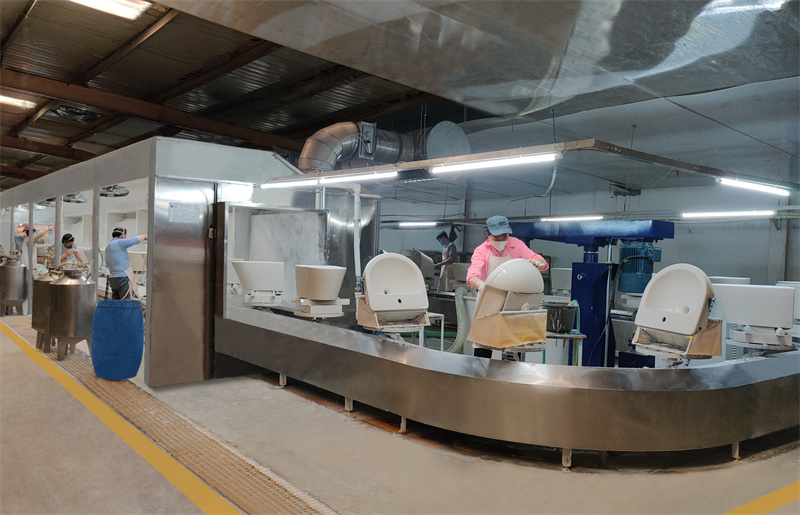
For facilities looking to scale operations, transitioning from disjointed batch processing to a continuous flow is a primary engineering objective. A well-implemented Cycle Glazing Line serves as the absolute backbone of high-volume sanitary ware production.
Traditional application often operates on a frustrating stop-and-go basis. Products are manually loaded into a booth, sprayed, removed, and staged for drying. This intermittent handling creates severe bottlenecks on the factory floor. A continuous line resolves this friction by integrating motorized conveyor systems with synchronized robotic spraying stations.
Specifically, as the ceramic body enters the active zone, optical position sensors dictate the exact millisecond the spray sequence begins. The conveyor speed is mathematically synchronized with the robotic arm movement path. Because of this continuous loop, as one piece is being coated, the next is already moving into position. This seamless synchronization effectively eliminates idle time and maximizes daily throughput.
Sanitary ware catalogs typically include a wide variety of complex geometries, ranging from intricate one-piece toilets with hidden traps to sleek, flat washbasins. To handle this diversity, advanced cycle lines are engineered for ultimate flexibility. Through the use of radio frequency identification tags, barcode scanners, or laser sensors, the system automatically identifies the specific product entering the booth.
Once identified, the central control unit instantly switches the robotic spraying program to match the unique geometry of the product. This intelligent capability allows manufacturers to run mixed batches without requiring manual recalibration or suffering extended downtime for changeovers.
Glaze represents one of the highest ongoing material costs in ceramic manufacturing. Addressing the glaring inefficiency of traditional application methods is usually the primary financial driver for equipment upgrades.
In standard pneumatic spraying applications, transfer efficiency is a massive concern. Industry data indicates that in traditional, non-optimized spray booths, up to forty percent of the atomized glaze fails to adhere to the ceramic body. This overspray is typically washed away into wastewater treatment systems or collected as unusable, heavy solid waste. For a facility processing hundreds of units daily, this loss equates to thousands of gallons of wasted raw material annually.
To combat this severe material loss, a dedicated Glaze Recovery System is engineered to capture, filter, and reintroduce overspray back into the active production cycle. The mechanics involve several tightly integrated stages.
High-velocity extraction fans pull the overspray toward a water curtain or dry filtration wall, preventing the material from settling on the floor or escaping into the factory air. The captured slurry is then channeled through smooth stainless steel pipelines into a primary collection tank. Next, the slurry is pumped through vibrating sieves to remove large particulates, dust, and organic impurities. Powerful magnetic filters extract any iron particles introduced during the pumping process, which would otherwise cause disastrous black spots on the fired ceramic. Finally, the recovered material is monitored for specific gravity and viscosity, automatically mixing with virgin glaze to return it to optimal application parameters.
While investing in recovery infrastructure requires initial capital, the payback period is often surprisingly short due to immediate, tangible material savings. The table below outlines typical operational shifts after an upgrade.
Performance Metric | Traditional Manual Booth | Automated Booth with Recovery System |
|---|---|---|
Initial Transfer Efficiency | 60% to 70% | 60% to 70% |
Net Material Wasted per Cycle | 30% to 40% | Under 5% after recycling |
Waste Disposal Costs | High sludge removal fees | Minimal environmental footprint |
Material Cost Savings | None | 25% to 35% Annual Reduction |
Estimated Payback Period | Not Applicable | 14 to 24 Months |
When evaluating capital equipment for ceramic manufacturing, plant managers must look far beyond basic brochure specifications. A high-performing Sanitary Ware Glazing Machine relies on precise engineering, reliable software integration, and consistent mechanical execution. Understanding the exact features that drive operational stability is critical for making an informed purchasing decision.
The complex curves of sanitary ware present unique challenges for automated spraying. Standard linear spraying mechanisms are entirely insufficient. Modern equipment typically integrates six-axis robotic arms from leading industrial brands to replicate and optimize fluid human wrist movements.
When selecting a machine, carefully evaluate the programming interface. The most effective systems utilize offline three-dimensional simulation software alongside point-to-point teaching pendants. This allows your engineers to program precise spray paths that maintain a consistent distance and angle relative to the ceramic surface, ensuring that even the most difficult-to-reach areas receive an even coating.
Consistent application is heavily dependent on fluid dynamics. Minor variations in viscosity, ambient temperature, or pump pressure can lead to significant quality deviations. Therefore, advanced machinery must incorporate smart sensors and closed-loop fluid control systems.
Look for equipment featuring precision diaphragm pumps and pneumatic atomization nozzles monitored by real-time flow sensors. These components adjust the spray output dynamically. If the line pressure drops, the system instantly compensates to maintain the required flow rate, guaranteeing uniform thickness across the entire batch.
In a high-volume manufacturing setting, every minute a machine sits idle for cleaning translates directly to lost revenue. Glaze is inherently abrasive and prone to rapid hardening, which can degrade moving parts and block delicate spray nozzles.
Top-tier equipment is engineered specifically with rapid maintenance in mind. Key features should include automated self-cleaning cycles that flush the fluid lines and nozzles with pressurized water at the end of a shift. Additionally, the physical design of the booth should feature quick-release stainless steel panels, modular internal components, and sloped floors to facilitate rapid manual washdowns and prevent material accumulation in blind corners.
Quality control in sanitary ware manufacturing is heavily scrutinized because surface defects often only become visible after the energy-intensive firing process in the kiln. By this stage, correcting a defect is either impossible or prohibitively expensive. Automated machinery addresses the root causes of these defects during the initial application phase.
Pinholes and blisters are frequent defects caused by air entrapped within the coating layer or by organic impurities burning off during firing. In manual operations, inconsistent spray pressure or improper distance between the spray gun and the ceramic body often leads to this air entrapment.
Automated machinery mitigates this risk through precise pneumatic control. By maintaining a constant, optimized atomization pressure and a mathematically calculated distance from the substrate, robotic sprayers ensure a dense, uniform deposition of particles. When paired with a highly filtered recovery system, the risk of introducing particulate impurities into the mixture is significantly reduced.
Variations in thickness lead to severe aesthetic and structural issues. If applied too thinly, the fired product may exhibit a rough texture or inadequate water resistance. If applied too thickly, the material is prone to running, sagging, or crawling during the high-temperature firing process.
Manual application inherently struggles with consistency. In contrast, automated systems execute the exact same programmed motion path with identical flow rates for every single unit. This robotic consistency ensures that the thickness remains within the strict micron-level tolerances required by international quality standards.
Achieving high efficiency and low waste in modern ceramic manufacturing is nearly impossible without the right technological infrastructure. Upgrading your facility is no longer just about increasing capacity; it is about working smarter and drastically reducing the raw material waste that eats into your profit margins.
Investing in a continuous cycle line equipped with robotic precision and a robust recovery system is a smart financial decision that pays dividends in product quality, production speed, and environmental sustainability. For facilities ready to modernize, exploring tailored automation solutions and high-performance equipment from HXG Machine ensures you get the exact specifications needed to future-proof your manufacturing plant and maximize your return on investment.
Depending on the specific system filtration efficiency, the ambient conditions of the booth, and the geometric complexity of the sanitary ware being processed, empirical data indicates that manufacturers can successfully recover and reuse between fifteen and thirty percent of their total volume. Over an annual production cycle, this reduction in raw material waste translates to substantial financial savings, significantly shortening the equipment payback period.
Yes, advanced continuous lines are expressly designed for high-mix production environments. They utilize integrated barcode scanners, radio frequency tags, or optical laser sensors at the entry point of the spraying booth to identify the specific product type, such as distinguishing between a washbasin and a one-piece toilet. The central programmable logic controller processes this data instantly and commands the robotic arm to execute the corresponding pre-programmed spray path.
In a highly optimized automated setup utilizing precision pneumatic atomization nozzles and multi-axis robotics, initial transfer efficiency typically ranges from sixty to seventy percent. However, when integrated with a closed-loop water curtain recovery infrastructure, the effective utilization rate of the raw material pushes above ninety-five percent, virtually eliminating material waste.
Firing defects like crawling, blistering, and sagging are directly tied to uneven application thickness and entrapped air. Robotic systems maintain a mathematically precise distance and spray angle while utilizing closed-loop fluid control to keep pressure constant. This guarantees a uniform micron-level coating density, ensuring the piece reacts predictably and flawlessly to the thermal curve inside the kiln.
Industrial-grade machinery is constructed from heavy-duty, corrosion-resistant materials designed to withstand harsh manufacturing environments. With strict adherence to scheduled maintenance protocols, regular daily cleaning to prevent hardening, and the timely replacement of consumable wear parts like pneumatic nozzles and pump seals, a high-quality automated system typically maintains peak operational efficiency for ten to fifteen years.
Transitioning from manual spraying to automated operation requires a paradigm shift from physical labor to technical oversight. However, modern equipment is engineered with user-friendly human-machine interfaces and intuitive touchscreens. Operators primarily need to learn how to select programs, monitor sensor data, and perform routine cleaning protocols. Reputable machinery manufacturers typically provide comprehensive on-site training programs during the installation phase to ensure your staff is fully competent.


